When you build or manage Shopify stores for clients, the cookie banner is easy to treat as an afterthought. It usually gets added at launch, checked once and forgotten.
That’s risky. The consent app decides which scripts load before a shopper agrees, what signal reaches Google tags and whether choices flow through to Shopify’s own tracking. If it’s set up badly, a client’s analytics and ads can break, or tracking can run when it shouldn’t.
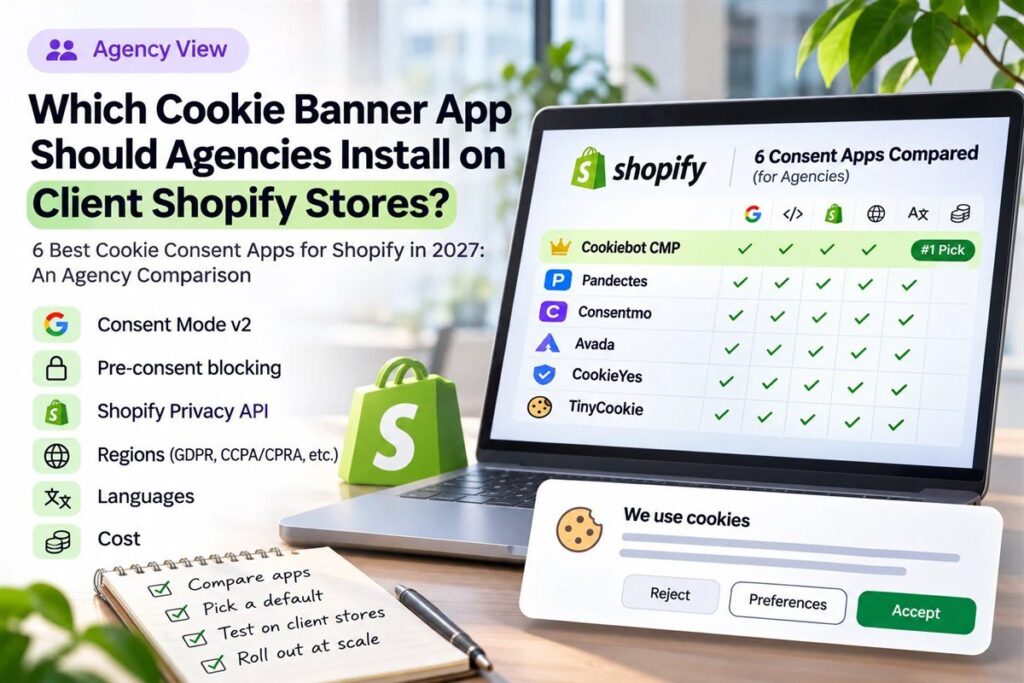
We compared six Shopify consent apps from an agency’s point of view, using public documentation and Shopify App Store listings. This is desk research, so test any app on a client store before you roll it out more widely.
Key Takeaways
- Our top pick includes Google Consent Mode v2 on every plan and blocks trackers until consent, which makes it a strong default across client stores.
- Pandectes and Consentmo suit larger clients that need advanced blocking, Shopify Plus checkout banners or headless support on higher tiers.
- Avada and TinyCookie offer low-cost paid tiers for Consent Mode v2, starting under USD 10 a month per store.
- CookieYes lists its consent essentials as free on Shopify, subject to fair-use conditions.
- No app guarantees legal compliance. Agencies should document what each client’s setup does and doesn’t cover.
How We Ranked These Apps
Agencies need an app they can deploy repeatably and explain to clients. We judged each one on six criteria:
- Google Consent Mode v2: which plan includes it.
- Script blocking before consent: whether scripts are held back until a visitor agrees, including any checkout support.
- Shopify Customer Privacy API support: whether visitor choices reach Shopify-managed pixels and tracking.
- Regulations covered: GDPR, CCPA/CPRA and other regional laws.
- Languages: support for clients selling in more than one market.
- Pricing per store: the plan a typical client would actually need.
Keep three things separate when you set up any of these apps. Blocking theme scripts, passing consent flags to Shopify and showing a banner at checkout are different jobs. An app that does one well doesn’t automatically do the others.
Quick Comparison
| App | Consent Mode v2 | Free plan | Paid plans (USD per month) | Best client fit |
|---|---|---|---|---|
| Cookiebot CMP | Every plan | Yes | Check vendor listing | Most stores |
| Pandectes | Plus plan | Yes | From 9 | Headless and Plus builds |
| Consentmo | Standard plan | Yes | 10, 37, 99 | Multi-region brands |
| Avada | Professional plan | Yes | 9.95, 23.95, 34 | Design-led stores |
| CookieYes | Free | Yes | Essentials listed as free | Budget clients |
| TinyCookie | Basic plan | Yes | 7, 12 | Small stores |
1. Cookiebot CMP
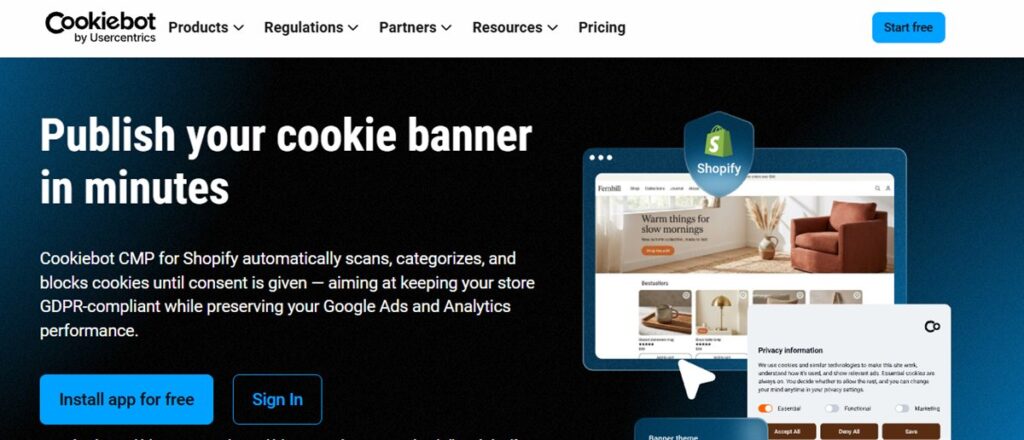
For agencies that want one dependable default, this is our top pick. Cookiebot combines automatic cookie scanning with tracker blocking that holds scripts back until a visitor consents, and it is a Google-certified consent management platform.
Google Consent Mode v2 is included on every plan, including the free one. That removes a common upsell conversation with smaller clients who run Google Ads or Analytics.
Key features:
- Automatic cookie scanning
- Blocks trackers until consent is given
- Google Consent Mode v2 on every plan
- Installs through the Shopify app or Google Tag Manager
Pricing: A free plan is available. Check the Shopify App Store listing for current paid plans.
Best for: Agencies standardizing on one consent app across most client stores.
2. Pandectes GDPR Compliance
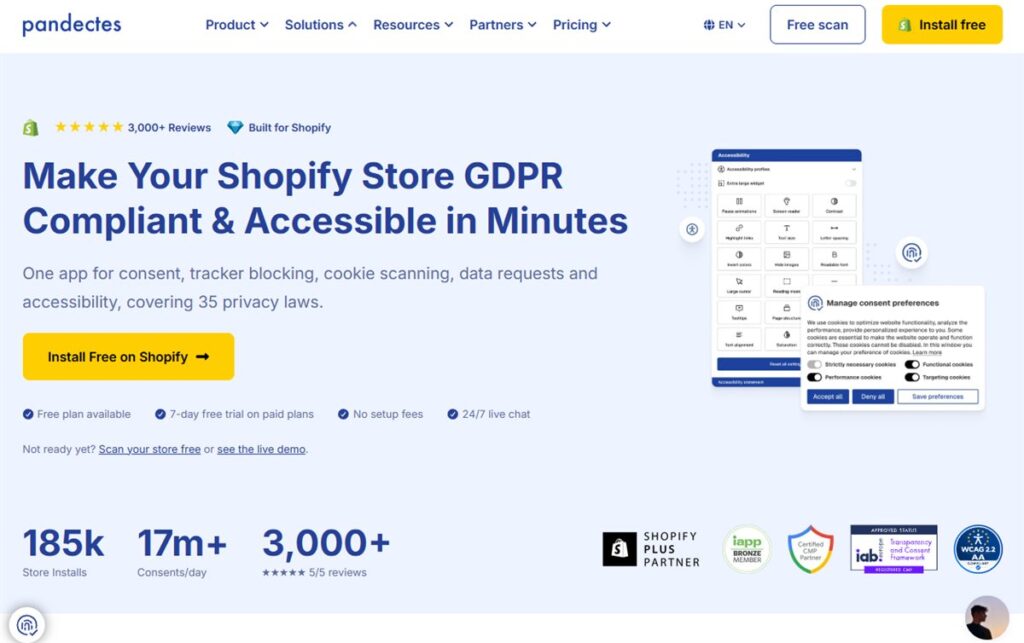
Pandectes has a free Basic plan and a built-in Shopify Customer Privacy API integration, so visitor choices reach Shopify’s systems. It covers GDPR, CCPA/CPRA, LGPD and other regional laws.
Consent Mode v2 starts on Plus. Higher tiers add advanced blocking, checkout banner options for Shopify Plus stores and support for headless builds.
Key features:
- Free Basic plan with a customizable banner
- Built-in Customer Privacy API integration
- Google Consent Mode v2 from Plus
- Headless store support on its top tier
Pricing: Basic is free, and Plus starts at USD 9 a month. Higher tiers cost more.
Best for: Agencies building headless or Shopify Plus stores that need room to grow.
3. Consentmo GDPR Compliance
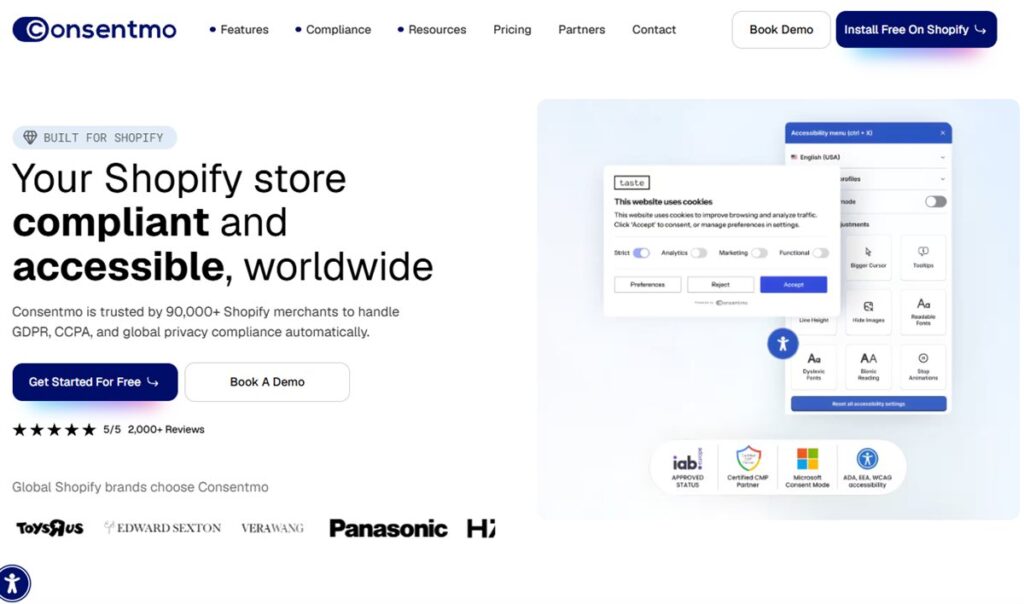
Consentmo pairs consent management with privacy-request tools, which helps when a client needs data subject requests handled in the same place. It integrates with Shopify’s Customer Privacy API.
The free plan includes basic script blocking and consent logs. Standard adds Consent Mode v2, unlimited scans and multilingual banners, while Max adds consent monitoring and a Shopify Plus checkout banner.
Key features:
- Basic script blocking and request tools on the free plan
- Google Consent Mode v2 on Standard
- Regional automation on Plus
- Monitoring and Shopify Plus checkout banner on Max
Pricing: Free, Standard at USD 10, Plus at USD 37 and Max at USD 99 a month.
Best for: Multi-region brands that want consent and privacy requests in one app.
4. Avada GDPR Cookie Consent
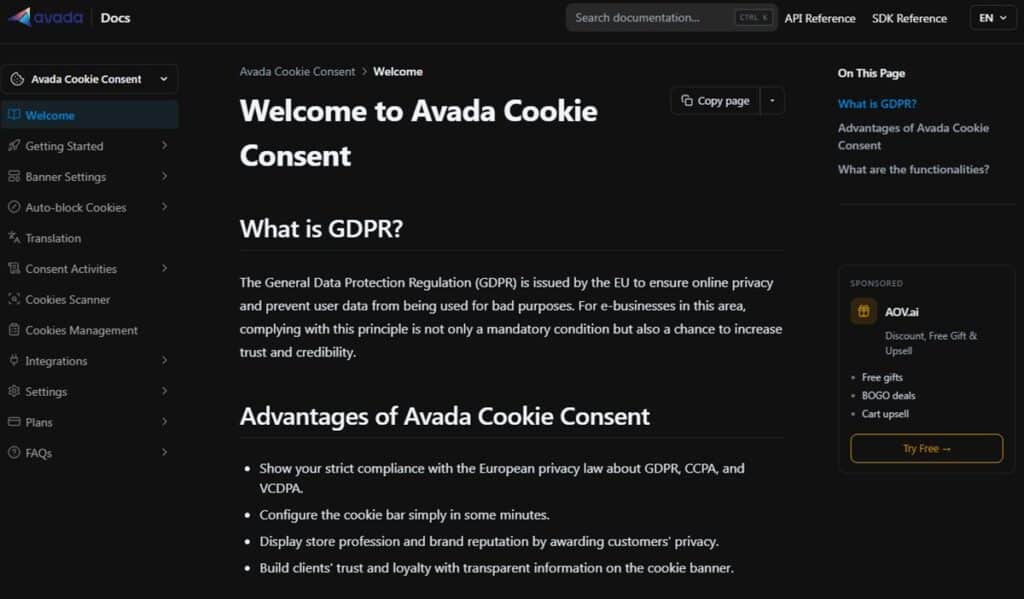
Avada lets merchants customize a banner on its free plan, so it’s useful for design-led clients who care how the banner looks. Its documentation also separates Shopify API consent from theme-script blocking, which helps with setup.
Consent Mode v2 and blocking for known integrations start on Professional. Custom rules and unlimited banner languages come with Advanced, and checkout banners on Enterprise require Shopify Plus.
Key features:
- Free banner customization
- Google Consent Mode v2 from Professional
- Custom blocking rules and unlimited banner languages on Advanced
- Checkout banners on Enterprise for Shopify Plus stores
Pricing: Free, Professional at USD 9.95, Advanced at USD 23.95 and Enterprise at USD 34 a month.
Best for: Design-focused clients who want a branded banner before paying for integrations.
5. CookieYes GDPR Cookie Consent
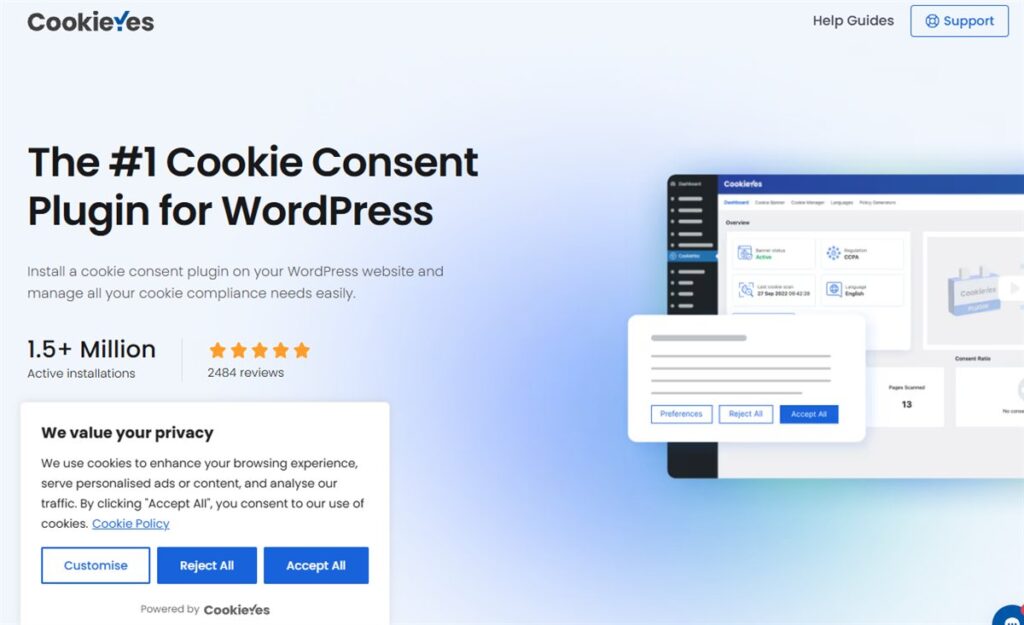
CookieYes lists its consent essentials as free on Shopify, including Google Consent Mode v2, consent logs and Shopify privacy integration. It also lists third-party script blocking and regional banners.
Free use is subject to fair-use conditions, and the free banner keeps CookieYes branding. Its language allowance is described differently across its materials, so confirm what a client’s markets need.
Key features:
- Google Consent Mode v2 listed as free
- Consent logs and regular scans
- Regional banners
- Third-party script blocking listed
Pricing: Essentials are listed as free within fair-use conditions.
Best for: Budget-conscious clients that accept a branded banner.
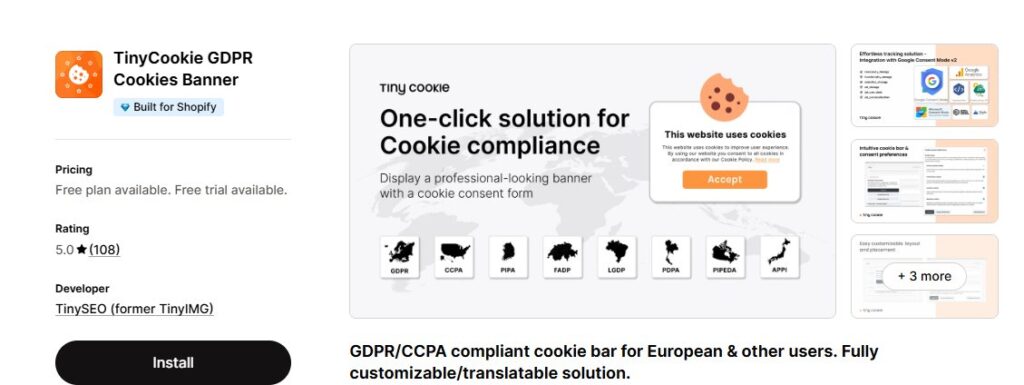
6. TinyCookie GDPR Cookies Banner
TinyCookie offers a simple path: a free customizable banner first, then integrations on Basic and scanning on Advanced. That makes it easy to explain to small clients.
Basic adds Google Consent Mode v2, Shopify Customer Privacy API integration, translations and consent logs. Advanced adds a cookie scanner and geolocation.
Key features:
- Free banner with accept, reject and preferences
- Google Consent Mode v2 and Privacy API integration on Basic
- Consent logs and translations on Basic
- Cookie scanner and geolocation on Advanced
Pricing: Free, Basic at USD 7 and Advanced at USD 12 a month.
Best for: Small stores that need a clear, low-cost upgrade path.
How Agencies Should Roll Out a Consent App
Start with a default. Choosing one app for most clients makes setup, training and troubleshooting faster across your portfolio.
Then match the tier to the client. A small single-market store may only need a free plan, while a Shopify Plus brand selling in several regions may need checkout banners and regional automation.
Next, test every store. Accept, reject and change preferences, then confirm that Shopify-managed pixels and Google tags behave as expected. Repeat those checks whenever a client adds a new marketing tool.
Finally, set expectations in writing. Shopify also supplies its own privacy controls, and no app guarantees GDPR, CCPA, CPRA or other legal compliance. Consent is one part of wider ecommerce compliance that also covers checkout and data security.
Conclusion
For agencies, the best consent app is the one you can deploy confidently across many stores and explain clearly to each client. Consent Mode v2, pre-consent blocking and Shopify Privacy API support are the features that matter most.
Our top pick earns first place by including Consent Mode v2 on its free plan. Pandectes and Consentmo suit larger or more complex clients, while Avada, CookieYes and TinyCookie offer low-cost options for smaller stores. Whichever you choose, test each store’s setup before handover.
FAQs
Do Shopify stores need a cookie banner?
Stores with visitors from regions that require consent, such as the EU under GDPR, generally need a way to collect consent before non-essential cookies are set. The exact requirements depend on where a client’s customers are.
Is Shopify’s built-in cookie banner enough?
Shopify provides a basic cookie banner in its customer privacy settings. Many stores add a dedicated app for script blocking, Google Consent Mode v2 support and more control over banner design and regions.
Which privacy law applies to a client’s store?
It depends on where the client’s customers are and how the business is set up. GDPR covers EU visitors, while CCPA/CPRA applies to businesses that meet certain thresholds and serve California residents. This isn’t legal advice, so clients should consult a qualified professional.
Can one consent app work across all client stores?
Often, yes. Standardizing on one app simplifies setup and support, though some clients may need a different tier or app for headless builds, checkout banners or specific regions.
How often should consent setups be checked?
Check after launch and again whenever a client adds or changes a tracking or marketing tool. New scripts can bypass an outdated setup.