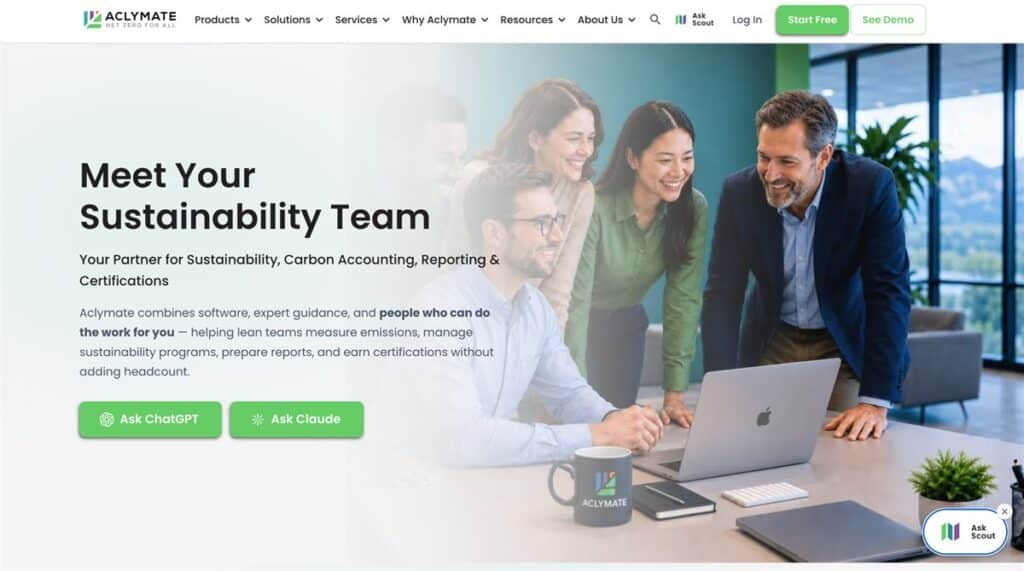
Imagine taking your company name and logo off your homepage. Now replace them with a competitor’s name. Would the page still make sense? If the headline says “Quality Service You Can Trust,” the answer may be yes. If the supporting copy promises “innovative solutions,” “customer-focused service,” or “years of experience,” a dozen nearby businesses could probably make the same claims.
That does not necessarily mean the claims are false. It means they are not doing enough work. Generic homepage copy makes visitors figure out what is different about the business, who it serves, and why they should choose it. Most visitors will not spend long solving that puzzle.
The good news is that you can spot this problem quickly. The competitor-swap test is a simple homepage audit that reveals where vague language is hiding and what details can make the message more specific, useful, and believable.
What Is the Competitor-Swap Test?
The test asks one question: Could a direct competitor replace your logo with theirs and leave most of the homepage unchanged?
You are looking for words that sound positive but do not identify your business. Common examples include: Quality workmanship. Exceptional customer service. Trusted local experts. Customized solutions. Competitive pricing. Your satisfaction is our priority. We go above and beyond.
These phrases are familiar because they apply to almost every responsible company. They may support a stronger message, but they rarely make a strong message on their own. A useful homepage should help a visitor quickly understand: What you do, Who you do it for, Where you work, Which problems you solve, How your service is delivered, What evidence supports your claims, & What the visitor should do next. The more clearly your homepage answers those questions, the harder it becomes for a competitor to claim the page as their own.
Why Generic Homepage Copy Costs Opportunities
Website visitors arrive with limited attention. They may be comparing several tabs, searching from a phone, or trying to make a decision between appointments. Vague language forces them to hunt for basic information.
It hides relevance
“Professional solutions for every need” does not tell a homeowner whether you repair slab leaks. “Helping North Texas homeowners locate and repair slab leaks” does.
Specific copy lets the right visitor recognize a match without reading every paragraph.
It weakens trust
Anyone can type “trusted” into a headline. Trust grows when a page provides evidence: a licensing number, a service guarantee, a documented process, recognizable clients, verified reviews, before-and-after work, or years serving a defined community.
It encourages price-only comparisons
When several companies sound identical, price becomes the easiest visible difference. Specific messaging gives customers other reasons to compare: specialization, speed, process, availability, service area, experience with a particular problem, or the type of support included.
It makes referrals work harder
A referred visitor may already feel positive about your business. But if the homepage does not confirm what the referrer said—“they specialize in older homes,” “they always explain the options,” or “they handle the permits”—the recommendation and the website tell different stories.
Run the Test in 10 Minutes
You do not need a branding workshop to find the first improvements. Open the homepage and review it from top to bottom.
Step 1: Cover the brand name
Temporarily ignore the logo, business name, and branded colors. Read the headline, subheadline, buttons, service summaries, testimonials, and closing call to action. Ask: Can I identify the exact service without using the navigation? Can I identify the customer or situation this page is for? Is the location meaningful, or does the page only say “local”? Does the page contain a detail a competitor could not honestly copy?
Step 2: Highlight interchangeable claims
Mark every sentence that could appear on a competitor’s page unchanged. Do not delete everything immediately. First, separate broad promises from useful facts.
For example:
- Broad promise: “We provide fast, reliable service.”
- Useful fact: “Our Bedford-based team schedules most DFW service calls within two business days.”
The first sentence may introduce a benefit. The second gives the visitor something concrete to evaluate.
Step 3: Circle the proof
Find the evidence supporting each major promise. Proof can include: Specific review excerpts tied to a service. Project photos with explanatory captions. Credentials, certifications, licenses, or memberships. A measurable response time or service standard. A clear warranty or guarantee. A short explanation of your process. Named neighborhoods, cities, industries, or property types served. Real team members and their relevant experience If a claim has no proof nearby, decide whether to add evidence, make the claim more precise, or remove it.
Step 4: Check the call to action
“Learn More” is rarely wrong, but it is often incomplete. Tell visitors what happens next. More useful calls to action might be: Request a website review. Schedule a 15-minute project call. Get a written roof-repair estimate. Check service availability in your ZIP code. Send photos for an initial assessment. A specific button reduces uncertainty and helps qualify the click.
Replace Superlatives With Details
The easiest rewrite is often not a more exciting adjective. It is a useful detail.
Consider these transformations:
- Generic: “We offer personalized solutions.”Specific: “Your website plan is built around the services, cities, and inquiries your team wants to grow.”
- Generic: “We are experienced professionals.”Specific: “Our team has designed and supported small-business websites across North Texas since 2010.”
- Generic: “Customer service is our top priority.”Specific: “Support requests go to a local team that already knows your website and hosting setup.”
- Generic: “We serve a wide range of clients.”Specific: “We build lead-generation websites for contractors, professional services, medical practices, and local retailers.”
The specific versions are not louder. They are easier to understand and verify.
Five Sources of Homepage Differentiation
You do not need to invent a dramatic slogan. Most useful differences are already inside the business.
1. A clearly defined customer
Name the people, industries, property types, or situations you serve best. “Commercial electricians for occupied medical and office buildings” is more helpful than “electrical services for everyone.”
2. A recognizable process
Explain how the customer moves from inquiry to result. A three-step process can distinguish a company that communicates clearly from one that leaves customers guessing.
3. Operational details
Mention details customers care about: who answers the phone, whether estimates are written, how quickly appointments are scheduled, what preparation is required, what happens after completion, and which support is included.
4. Relevant proof
Choose proof that supports the decision at hand. A review about polite technicians is valuable; a review describing how the team solved the exact problem a visitor has is stronger.
5. Honest boundaries
Being clear about what you do not do can improve fit. Service areas, minimum project sizes, timelines, exclusions, and ideal-customer details help the right prospect move forward with confidence.
Keep Differentiation Believable
Specificity is powerful only when it is accurate. Avoid turning every detail into an absolute promise. Before publishing a rewrite, verify that: Response times reflect normal operations. Service areas match where the company actually works. Credentials and numbers are current. Guarantees include necessary conditions. Testimonials are used with permission and remain faithful to the source. “Only,” “best,” “fastest,” and similar claims can be supported. It is better to make a modest, credible statement than an impressive claim your team cannot consistently deliver.
A Practical Homepage Message Formula
A strong homepage opening can often be built from four parts:
- Service: What do you provide?
- Audience or situation: Who is it for?
- Meaningful difference: How is your approach useful?
- Next step: What should the visitor do?
For example:
DFW websites for local service businesses that need better-qualified leads—not just more traffic. See our design process or request a project conversation. That statement will not fit every web design company. It identifies a market, a desired outcome, a point of view, and two clear next steps.
Where to Prioritize Your Rewrites
Do not try to replace every sentence in one sitting. Start with the areas visitors are most likely to see: Homepage headline and subheadline. First primary call-to-action button. Opening service summaries. Trust or proof section. About-section introduction. Final call to action. Page title and search-result description.
After updating those sections, repeat the test on your most important service page. The goal is not to make every line unique. Functional labels such as “Contact Us” can remain familiar. Focus on the copy that explains value, fit, proof, and the next step.
Your Homepage Should Sound Like Your Business
A professional homepage does not need clever wordplay. It needs enough truth and detail that the right customer recognizes the business behind it.
Run the competitor-swap test today. Cover the logo, highlight the interchangeable claims, circle the proof, and rewrite one high-visibility section with concrete details. Even a small change can make the page easier to understand and harder to confuse with everyone else.
If your homepage could use a clearer message, DFW Website Designers can help review the content, structure, and next steps. Call 817-247-6003 to start a conversation about your website.