Picture a plumbing company in Arlington whose homepage calls it an eco-friendly plumber. There’s no reporting period, no number, and no explanation of what eco-friendly covers. A customer cannot check the claim. US environmental-marketing guidance addresses this problem: it is deceptive to misrepresent, directly or by implication, that a product or service offers a general environmental benefit.
A useful website statement lets readers trace the claim back to records. Below, five carbon footprint software options are compared by how they can help a small service business organize that evidence. The numbering is presentation order, not a performance ranking. The comparison draws on public documentation checked on November 5, 2026, rather than hands-on testing.
Software can organize carbon data, but the wording on your website still needs to match what you measured.
What makes a sustainability claim supportable
A supportable claim identifies its subject, reporting period, included activities, calculation method, and limitations. The subject might be the business, a location, a service, or a product. Leaving these details out makes readers guess what the statement covers.
Carbon accounting tools sort emissions into three groups. For a home-service company in Plano, Scope 1 might include fuel burned in company trucks and gas-powered equipment. Scope 2 includes purchased electricity for the office and warehouse. Scope 3 covers other indirect emissions, such as purchased parts, waste disposal, and subcontractor travel. Use these labels in the software. On the website, plain language such as “fuel for our service vehicles” will be clearer; technical labels can go in the methodology note.
Keep related terms distinct. An estimate is a calculation that relies on assumptions. An inventory accounts for emission sources within defined boundaries and a reporting period. A reduction target is a goal; an achieved reduction is a measured difference between comparable periods. Independent assurance involves a third party reviewing the inventory. The GHG Protocol Corporate Standard helps organizations develop a verifiable inventory, but it does not set out how verification should be conducted.
Match the evidence to the claim. A company-wide inventory may support a statement about the company’s footprint. It does not establish that an individual water heater installation is low-carbon. Sage’s sharing guidance warns that a business footprint is not a product footprint and advises against directly comparing footprints with other businesses. Different boundaries and methods can make “greener than the other guys” unsupported even when both calculations are sound.
Qualify the promise. Visitors respond to specific proof more than to broad adjectives, and environmental claims are no exception. Replace “We’re a green HVAC company” with a statement readers can check: During [period], we estimated [defined emissions] for [locations/activities] using [method]; [exclusions] are not included. The Green Guides’ general principles say qualifications and disclosures should be clear, prominent, and understandable. Put essential qualifications beside the claim rather than leaving them in a footer or behind a link.
Keep reductions separate from offsets. Buying offsets does not change how much fuel your trucks burned. The FTC’s Green Guides summary says carbon offset claims need competent and reliable scientific evidence. If you bought offsets, describe them separately rather than folding them into an operational reduction figure.
How the five carbon footprint software options compare
The comparison uses public pricing pages, product pages, help centers, and announcements checked on November 5, 2026. The fit descriptions are editorial judgments for an owner-managed service business, not findings from product testing.
Each option was assessed on data entry, emissions coverage, traceability to source records, reports available for review, assistance, and pricing transparency. The table summarizes the documented capabilities and questions to resolve before choosing a plan.
| Option | Best-fit situation | Evidence-related capability | Pricing model | Limitation to check |
|---|---|---|---|---|
| 1. Aclymate | First estimate for a service business, with a paid path forward | Guided emissions survey; activity-based and spend-based calculations in Navigator | Explorer is free; Navigator displayed USD 538 per year for the captured 1 to 10 employee annual-billing selection | Which exports and reports each tier includes at your employee count |
| 2. Sweep | Connecting corporate, supplier, and product data | Reporting that traces figures to source information, methodology, and version history, according to the vendor | Demo and contact process; no public subscription amount established | Which features your quote includes and whether their breadth fits your needs |
| 3. Persefoni Pro | Free self-service inventory | Scope 1, 2, and 3 calculations aligned with the GHG Protocol | Free with no trial expiration; optional paid reporting and support upgrades | Single-user default; some detailed reports and collaboration options are paid |
| 4. Greenly | Assessment plus reduction-planning guidance | Cross-scope calculations and supplier-data traceability described by the vendor | Customized packages, quoted | Which support, supplier, and lifecycle services the package includes |
| 5. Greenplaces | An inventory built and maintained by an expert team | Factor choices and methodology traceable to source, according to the vendor | Strategy call; no public subscription amount established | Which integrations, updates, and report outputs the quote includes |
Start with the statement you need to support. Draft the sentence you want to publish, then list the records and calculations it requires. A company-wide estimate, a product footprint, and a claim about an achieved reduction need different evidence.
A commercial subscription is optional for a first inventory. EPA’s free Simplified GHG Emissions Calculator helps organizations estimate and inventory annual emissions. It is primarily intended for small and medium organizations beginning greenhouse gas management, and its process starts with defining boundaries. That exercise can help you decide what you need from paid software.
1. Aclymate: a first estimate with a path to support
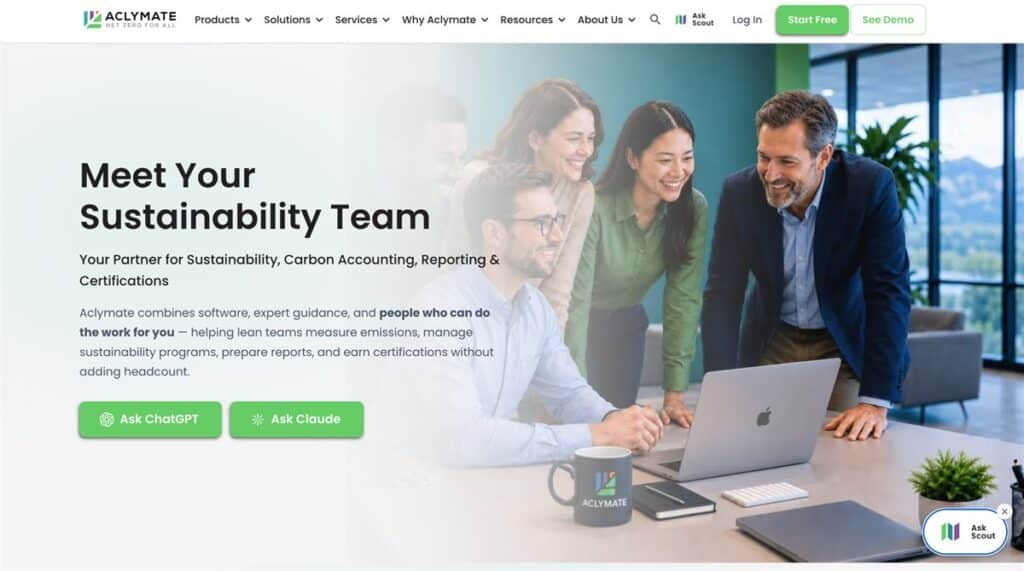
Aclymate offers a free starting point and paid options for more involved work. It describes Explorer as a tool that produces directional Scope 1, 2, and key Scope 3 estimates from a guided survey and basic business activity inputs. The pricing page identifies it as free forever rather than a time-limited trial.
What it helps you collect. Aclymate’s plan comparison lists accounting and utility integrations as included in Navigator and limited in Explorer. For a Fort Worth landscaping company, the underlying records could mean electricity bills, fuel card statements, and equipment invoices. Gathering those records is a practical first step before choosing what to say publicly.
Navigator is the core carbon-accounting, reporting, and sustainability-management platform. Its documented capabilities include activity-based and spend-based calculations. Activity-based calculations use quantities such as gallons or kilowatt-hours with an emission factor. Spend-based calculations use purchasing amounts and category averages. Record which approach you used so the website’s supporting methodology can explain it.
Website use case. Explorer gives a small service company a way to estimate its business footprint before writing a public statement. Describe the result as an estimate and identify the period, activities, and limitations. A business estimate does not establish a per-job footprint or justify a comparison with another company.
Pricing and limits. Aclymate’s displayed prices depend on employee count and billing selection. For the captured 1 to 10 employee annual-billing configuration, Navigator showed a rounded USD 45 monthly equivalent and a USD 538 annual charge. The monthly equivalent is not a month-to-month price; use the displayed annual total rather than multiplying the rounded figure.
The same configuration showed Aclymate One, which combines software and expert support, at a USD 448 monthly equivalent, billed annually at USD 5,376. This provides an option for businesses that want assistance beyond the software.
Check before choosing. Confirm the price for your employee count and billing choice. Ask which exports and reports each tier includes, and whether they show the calculations, source records, and emission factor versions a reviewer would need.
2. Sweep: connecting supplier and product carbon data
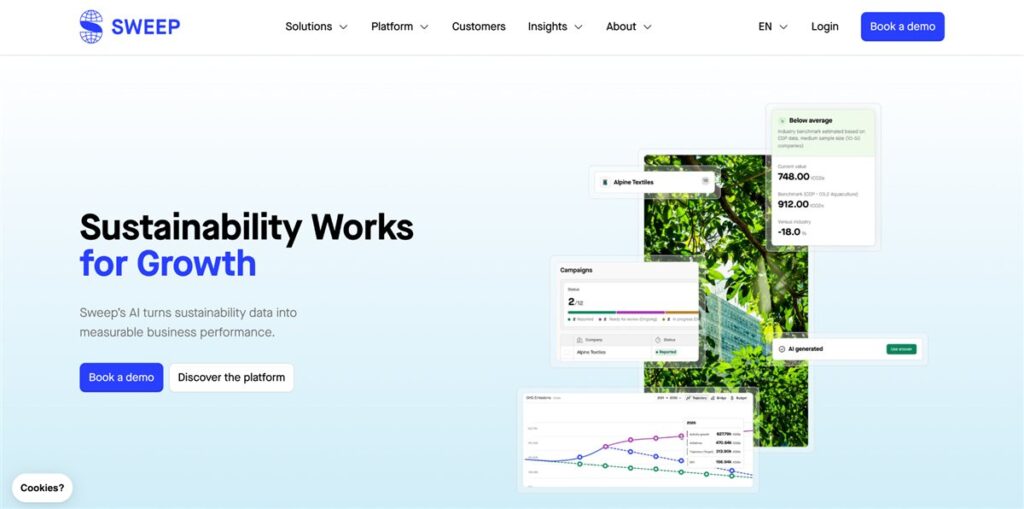
Sweep’s carbon-management offering brings together corporate footprints, product footprints, and reduction planning. That makes it an option to evaluate when a growing business needs to connect company-wide emissions with supplier inputs and product data.
A corporate footprint covers the business within defined boundaries. A product footprint addresses a defined product and set of lifecycle stages. Reduction planning explores how future choices could change emissions. These capabilities help organize different types of evidence; an achieved reduction still requires measurement across comparable periods.
What it helps you collect. For supplier data, it describes supplier interfaces for collecting primary Scope 3 data at scale, and states that every calculated figure can be traced back to its original source, methodology, and version history. These are vendor-described capabilities to confirm against the reports your business needs.
Website use case. A DFW service company that also sells a private-label product line may need supplier evidence beyond its office energy bills. Its product footprint workflow covers lifecycle emissions from raw materials to end of life, aligned to ISO 14067 and the GHG Protocol Product Standard, with emission factors reusable across a product catalog. This offers a route for collecting product-level information. The resulting website statement must still reflect the data’s boundaries, assumptions, and limitations.
What to verify. Ask which activities and lifecycle stages a product footprint includes, how estimates are distinguished from measured data, and what a reviewer can inspect without a platform login. Confirm which reporting, supplier, and product-footprint features are included in your quote.
Pricing and fit. The reviewed commercial pages direct prospective customers to a demo and contact process. No public subscription amount was established, so request pricing rather than relying on an estimate. Match the proposed package to your workload: a company coordinating supplier and product data has different needs from an owner documenting one office and a few trucks.
3. Persefoni Pro: a free self-service inventory
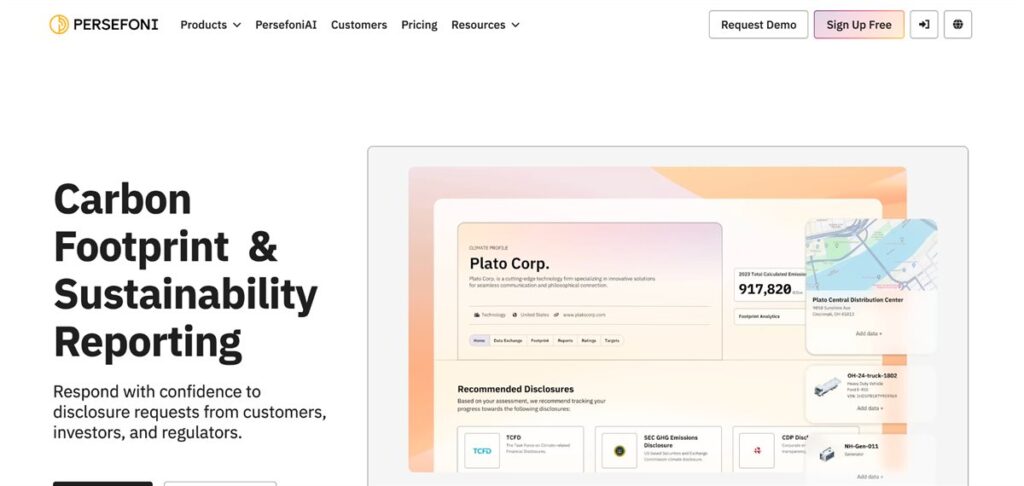
Persefoni’s pricing page describes Pro as free, with no trial expiration. It gives an owner a way to build an inventory before deciding whether paid reports, support, or collaboration features are needed.
What it supports. Persefoni advertises Scope 1, 2, and 3 calculation coverage aligned with the GHG Protocol. Alignment describes the accounting approach; it does not certify a customer’s figures or website claims. As with any inventory, the published statement must account for the inputs, assumptions, and exclusions.
Persefoni Academy provides learning resources on carbon accounting and climate disclosure. These can help an owner understand the calculations and terminology. A Persefoni blog post on free carbon footprint tools also says Pro can handle companies operating internationally, but it does not establish a complete supported-country list. Confirm coverage for your operations rather than assuming every location or activity is supported.
Website use case. An owner running a residential electrical company across Dallas and Collin counties could use Pro to build a full-year inventory, review the main emission sources, and then choose a statement that matches the evidence. Keep measured inputs and estimates identifiable in the supporting records.
Pricing and limits. Pro’s default account is single-user. The pricing page distinguishes paid collaboration and detailed-report options from the free plan, so a free account may not cover shared access or every report a reviewer requests. Optional reporting and support upgrades should be considered separately from the free inventory.
Check the output. Before entering your records, confirm whether the required export, methodology report, user access, and assistance are available at the free level. If your claim depends on a paid feature, compare the complete cost with other options rather than comparing free entry points alone.
4. Greenly: assessment with reduction-planning guidance
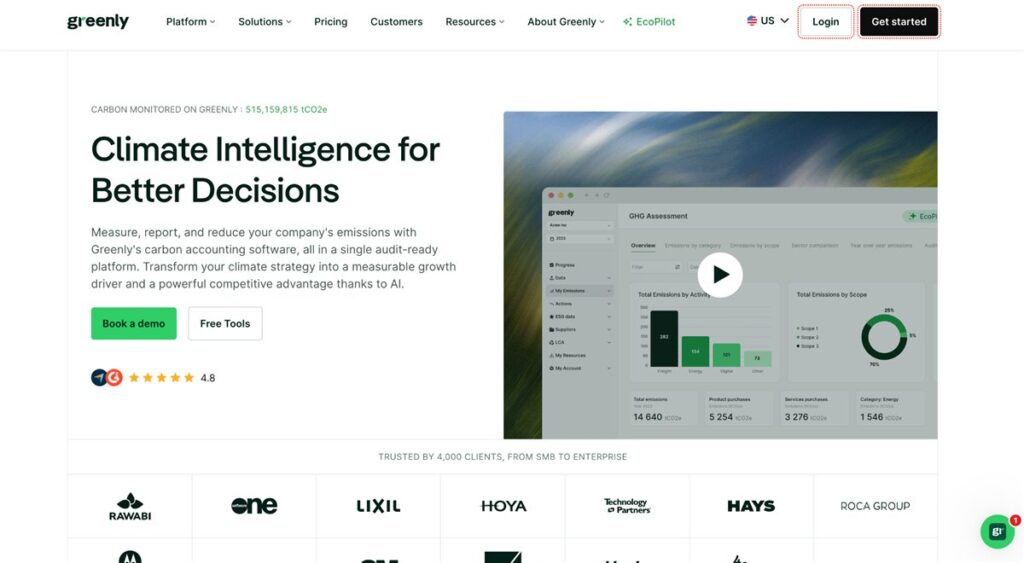
Greenly describes an assessment across emissions scopes, with guidance for identifying reduction opportunities. This approach may suit a business that wants to document its current footprint and develop a plan. An identified opportunity remains a proposed action until later measurements establish the result.
What it supports. Greenly’s sustainable procurement page says supplier data is benchmarked, confidence-rated, and traceable to its source. That describes a supplier-data capability, rather than independent assurance of every resulting figure. Confirm whether the relevant supplier-engagement features are included in the package you are considering.
Website use case. A roofing company in Denton that wants to publish a measurement and a goal can keep them in separate sentences. One should explain what was measured, for which activities and period. The other should state what the company intends to change and by when. This keeps a future commitment from sounding like an achieved result.
Pricing and limits. Greenly’s US pricing page describes customized sustainability packages with flexible pricing and bundle discounts. No verified starting price was established for this comparison. Request a quote that identifies the included workshops, support, supplier-engagement features, and lifecycle services rather than assuming every advertised capability is part of the package.
Greenly and Normative announced their merger in September 2026. Greenly said no changes were planned to existing contracts or pricing as a direct result. For a new purchase, confirm the current package, who will deliver the work, and which capabilities are available now. The announcement alone does not establish that every planned integration is complete.
5. Greenplaces: an expert-built inventory for customer questionnaires
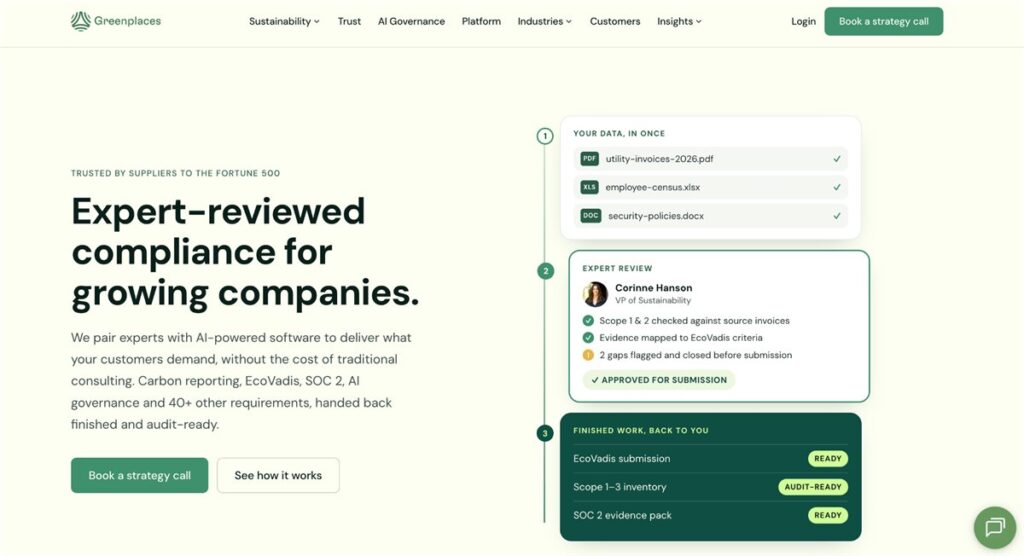
Greenplaces pairs its platform with a team that builds and maintains the emissions inventory. Its carbon accounting page describes a Scope 1, 2, and 3 inventory aligned with the GHG Protocol and structured to feed the frameworks customers ask about, such as CDP, EcoVadis, and SBTi. This approach may suit an owner who wants specialists to handle the calculations rather than entering them in-house.
What it helps you collect. The platform connects to finance systems, HR systems, utility providers, travel platforms, and supplier records to pull activity data. Utility accounts can be connected directly, and the company describes broad US coverage. Its experts select emission factors by category and geography, document allocation methods, and define scope boundaries, with each choice traceable to its source.
Website use case. A commercial electrical contractor in Irving that receives sustainability questionnaires from corporate clients may want one inventory that serves both the questionnaire and its website. The same figures can support both, as long as the published statement names the period, the activities covered, and what was left out. Ask how expert decisions about boundaries and factors are documented so the website’s methodology note can explain them.
Pricing and limits. Greenplaces directs prospective customers to book a strategy call, and no public subscription amount was established for this comparison. Because the service model includes expert work, compare any quote with software-only options on the full annual cost rather than the platform fee alone.
Check before choosing. Ask which integrations are available for your accounting and utility providers, what the inventory report shows a reviewer, and whether annual updates are included or billed separately.
Turn carbon data into website copy readers can check
Use the software’s outputs alongside your source records and a review process. The following steps connect the calculation to the wording readers will see.
Define the claim. Write the proposed sentence. Identify whether it covers the whole business, one location, a service, or a product, and specify the reporting period.
Preserve the source records. Keep bills, fuel statements, invoices, and exports together, labeled by period. Retain the records behind the figure rather than relying on a dashboard screenshot.
Review calculations and exclusions. Document activity-based and spend-based inputs, emission factor versions, and omitted sources. Lower fuel spending alone does not establish lower emissions; check the underlying quantities and use comparable methods for both periods.
Write the on-page qualification. Put the period, method, and essential exclusions beside the claim. A methodology page can provide detail, but it cannot correct a misleading headline that readers see on its own.
Publish supporting detail. Where appropriate, provide a descriptive link or downloadable report with the breakdown. Look for an output that connects each figure to its source records and version history, whether you use software or a spreadsheet.
Assign an update owner. Name the person responsible for reviewing the statement and set a review date. Update or remove wording when its supporting information no longer applies.
Keep one row per published claim in an evidence register:
- Exact wording on the page
- Subject: business, location, service, or product
- Reporting period and, for a reduction claim, baseline period
- Source documents and storage location
- Calculation method and emission factor version
- Status: estimate, inventory, target, or achieved reduction; any independent assurance
- Exclusions
- Reviewer and review date
- Next review date
Use these templates as starting points, filling each field from the supporting records.
Footprint statement. During [period], we estimated [defined emissions] for [locations/activities] using [method]; [exclusions] are not included.
Reduction statement. Between [baseline period] and [current period], our [defined emissions] for [locations/activities] decreased by [percentage], calculated using [method] with the same boundaries in both periods; [exclusions] are not included.
Label the unit as well as the number. Absolute emissions describe the total for a period. Per-job or per-product intensity divides emissions by output. A company can lower its intensity while increasing total emissions, so identify which measure a reduction claim uses.
The ICC’s November 2025 environmental-marketing framework includes a checklist addressing clarity, substantiation, and misleading impressions. It is international self-regulatory guidance, not US law. For a consequential claim, have a qualified reviewer examine the wording and evidence before publication. Carbon software and automated claim checkers do not replace legal advice.
Conclusion
A sustainability claim on a service business website holds up when a reader can trace it to a defined period, a stated method, and the records behind the figure. Carbon footprint software can organize that evidence, and the five options compared here take different routes: a free estimate, a self-service inventory, connected supplier and product data, guided reduction planning, or an expert-built inventory. None of them writes the website sentence for you.
Start with the claim you want to publish, choose the tool that produces the evidence that claim needs, and keep the qualification beside the wording. Separate estimates from inventories, targets from achieved reductions, and offsets from operational cuts. Then review the statement on a set schedule, and change or remove it when the supporting records no longer match.