Most compliance teams don’t lose time on decisions. They lose it on the groundwork before one: pulling registry data, chasing documents, mapping ownership chains and writing up cases so a reviewer can sign off. As customer volumes grow, that groundwork tends to grow with them.
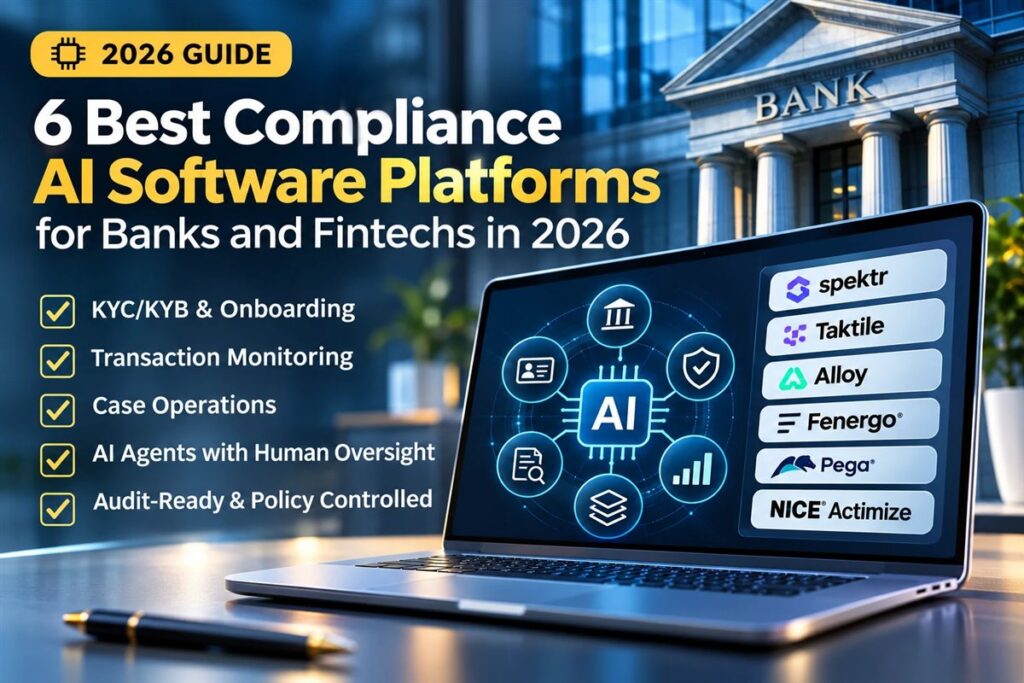
AI has moved from pilot projects into production compliance stacks, and the vendor landscape has shifted quickly. Some platforms started in onboarding, others in decisioning or transaction monitoring, and almost all now talk about agents. This guide compares six options on what matters to regulated teams: what the AI actually does, how decisions are recorded and where people stay in control.
Key Takeaways
- Compliance AI software is most useful on repetitive groundwork such as document review, data gathering and case preparation, while people keep ownership of final decisions.
- Auditability matters as much as automation. Look for a record of every action, the evidence used and the policy in force at the time.
- Platforms differ by starting point: onboarding orchestration, decision engines, client lifecycle management or AML monitoring.
- Teams that want Product, Operations and Compliance working from one system should weigh workflow ownership and policy enforcement closely.
- Certifications such as ISO/IEC 42001 show how a vendor governs its own AI.
What Is Compliance AI Software?
Compliance AI software applies machine learning, language models and AI agents to the operational work behind KYC, KYB, AML monitoring and case handling. The aim is to cut the steps analysts repeat thousands of times, not to remove the analyst.
In practice that means extracting data from IDs and incorporation documents, cross-checking it against registries, clearing obvious false positives and drafting case summaries. A human reviewer then approves, edits or escalates. The stronger platforms let teams decide where that handoff happens.
How We Chose These Platforms
We compared each vendor on five criteria that compliance, operations and product leaders raise most often:
- Coverage across onboarding, monitoring and case work
- How AI agents are built, configured and supervised
- Depth of the audit trail and decision traceability
- Configurability without engineering tickets
- Security and AI governance certifications
Information comes from each vendor’s own product pages and announcements. Features change quickly in this market, so confirm current capabilities during a demo.
Compliance AI Software at a Glance
| Platform | Core focus | AI approach | Best for |
|---|---|---|---|
| spektr | Onboarding, monitoring, transaction monitoring and case operations | Configurable AI agents held to your own policies | Configurable, audit-ready compliance infrastructure |
| Taktile | Credit, fraud and KYC/KYB decisioning | Agent templates inside a low-code decision engine | Unified risk decisioning |
| Alloy | Identity and fraud prevention | AI Assistant on a 270+ data solution network | Identity-heavy onboarding |
| Fenergo | Enterprise client lifecycle management | Six AI agents within FinCrime OS | Global KYC programs |
| Pega | Client lifecycle management and KYC | Agentic screening and document processing | Tier 1 banks on Pega |
| NICE Actimize | AML monitoring and investigations | Machine learning detection plus InvestigateAI | Enterprise AML operations |
The 6 Best Compliance AI Software Platforms
1. spektr
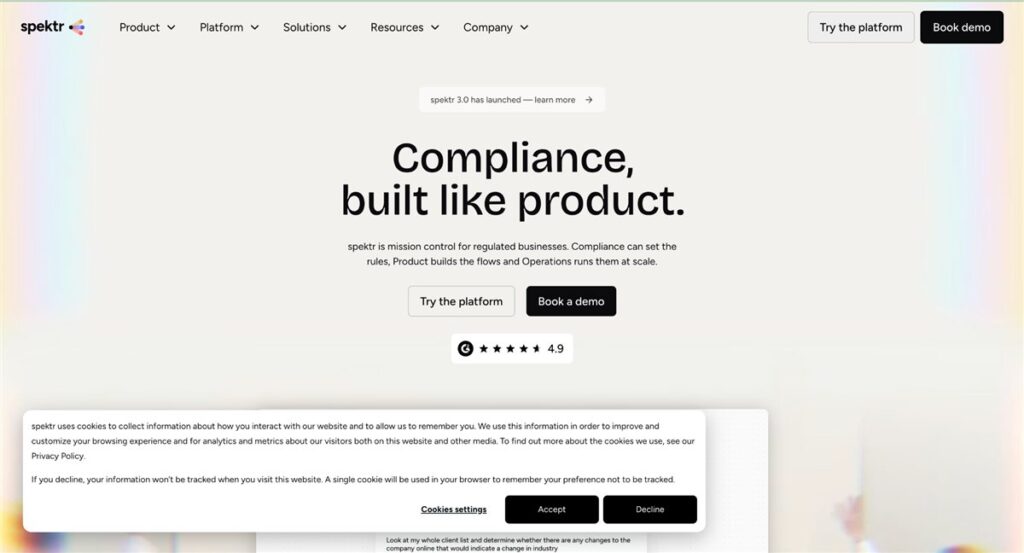
Built for banks, fintechs, PSPs and marketplaces, spektr puts onboarding, customer monitoring, transaction monitoring and case operations on one configurable platform. Teams build and adjust workflows themselves rather than waiting on an engineering queue.
AI agents handle routine work such as document review and ownership mapping, with configurable human-in-the-loop steps for calls that need judgment. A Policy Engine checks every process and agent against rules that compliance teams approve from their own policies.
Every action and approval lands in one traceable record, and the platform holds ISO 27001, ISO 27701 and ISO/IEC 42001 certifications with EU data hosting.
Best for: Mid-market and enterprise teams that want configurable, audit-ready compliance infrastructure across the customer lifecycle.
2. Taktile

Taktile is an agentic decision platform used by banks, fintechs and insurers for credit, fraud, KYC and KYB decisions. Risk teams build decision logic in a low-code editor with versioning and rollback.
Its AI Agent Manager offers pre-built agent templates for financial services use cases. A Case Manager hands escalated cases to agents that gather data, review documents and summarize findings, then routes anything ambiguous to human reviewers.
Its roots in credit and fraud decisioning make it a natural fit where compliance checks sit alongside underwriting logic.
Best for: Teams that want one decision engine across credit, fraud and onboarding risk.
3. Alloy
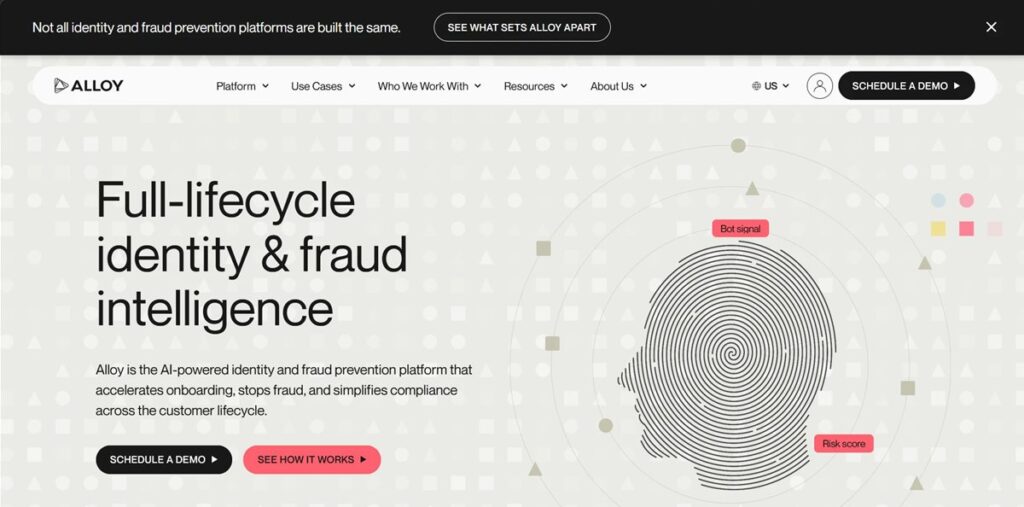
Alloy is an identity and fraud prevention platform used by more than 900 financial institutions and fintechs. It orchestrates a network of more than 270 data solutions for onboarding, fraud and compliance decisions through one layer.
In 2026 Alloy launched its AI Assistant, an agentic tool embedded in the platform that synthesizes data and recommends a decision a human can approve. Continuous risk assessment adjusts friction as customer behavior changes.
Its depth of data partners suits institutions that want to test and layer many identity sources.
Best for: Fintechs and banks that prioritize identity verification and fraud prevention at onboarding.
4. Fenergo
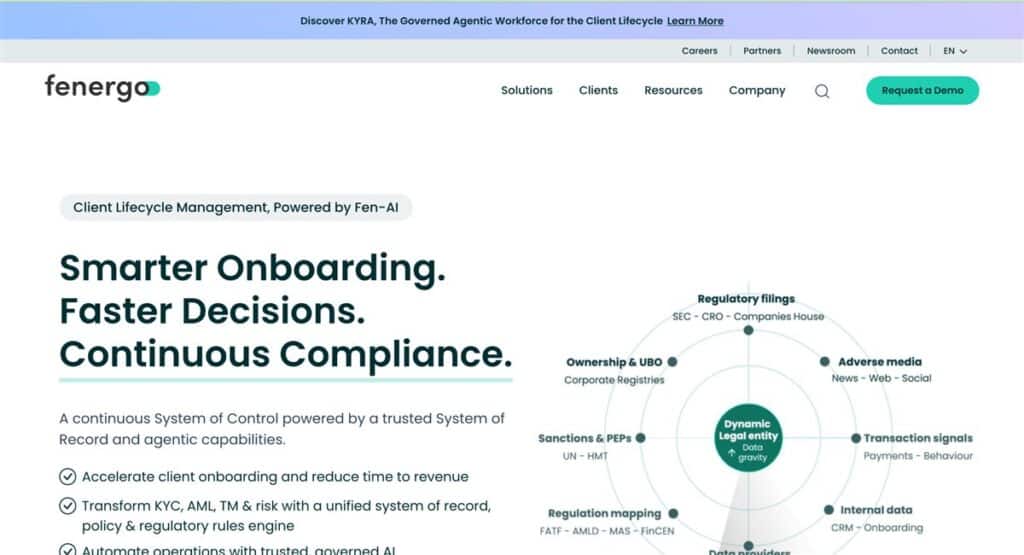
Fenergo provides client lifecycle management for enterprise banks and large financial institutions. Its FinCrime OS brings onboarding, KYC, screening, identity verification and transaction monitoring into one platform.
An agentic layer launched with six AI agents covering tasks such as data sourcing, document classification, screening and significance testing of data changes. A role-based dashboard gives teams oversight of agent activity.
Its strength lies in complex, multi-jurisdiction KYC and periodic reviews.
Best for: Large banks running global, multi-entity client lifecycle programs.
5. Pega
Pega Client Lifecycle Management supports onboarding, KYC and ongoing due diligence across retail, commercial and institutional banking. It runs on Pega’s broader workflow and case management platform.
A late 2025 release added agentic screening, generative AI document processing, automated requests for information and AI agents that give analysts regulatory guidance. Pega Cloud services and its GenAI solutions are certified to ISO/IEC 42001:2023.
Rollouts tend to be larger programs, which suits organizations already standardized on Pega.
Best for: Tier 1 banks with complex onboarding requirements and an existing Pega footprint.
6. NICE Actimize
NICE Actimize focuses on AML, fraud and financial crime detection for large financial institutions. Its Suspicious Activity Monitoring uses machine learning and graph analytics to detect suspicious transaction patterns.
The X-Sight ActOne case manager added agentic AI through InvestigateAI, which automates first-pass investigation work. Explainability features give analysts and auditors visibility into AI insights and actions.
Its depth sits in transaction monitoring and investigations rather than onboarding workflow design.
Best for: Large banks that need enterprise-scale AML monitoring and case investigation.
How to Choose the Right Compliance AI Software
A shortlist gets clearer once you know where your analyst hours actually go, the same starting point most AI automation projects use. These checks help separate platforms that look similar on paper:
- Start with the workload. Map whether time goes into KYB document chasing, alert triage or periodic reviews, then match vendors to that work.
- Check who can change workflows. If every rule change needs an engineering ticket, your roadmap will move at the speed of that queue.
- Ask how decisions are reconstructed. You want the evidence used, the rule or policy in force and who approved each step.
- Test human-in-the-loop controls. Confirm you can set review points by risk level, entity type or market.
- Review AI governance. The EU AI Act sets transparency and human oversight duties for high-risk AI systems, so ask vendors how they document both.
- Plan the connections. Ask how the platform links to your current data providers and core systems before you commit.
Final Thoughts
Compliance AI software earns its place when it takes groundwork off analysts’ desks and leaves a clear record behind. The six platforms here approach that from different directions, from decision engines and lifecycle suites to AML monitoring.
The right pick depends on where your hours go, how often your workflows change and how much control your compliance team needs over AI. Shortlist two or three, run them against your own cases and judge them on the evidence they produce.
Frequently Asked Questions
What does compliance AI software do?
It automates repetitive work in KYC, KYB, monitoring and case handling, such as data gathering, document review and case summaries, while people make the final calls.
Can AI agents replace compliance analysts?
No. Agents reduce manual tasks and prepare evidence, but regulated decisions still need human review and accountability.
What does human-in-the-loop mean in compliance automation?
It means a person reviews, approves or overrides AI output at set points in a workflow, often configured by risk level.
How is AI in compliance audited?
Strong platforms log each action, data source, decision and approval so teams can reconstruct why an outcome was reached.
What is ISO/IEC 42001?
It is an international standard for AI management systems, covering how organizations govern their AI use and manage the risks that come with it.