For years, we’ve told business owners that a great website needs to do two things:
- Look professional.
- Turn visitors into customers.
In 2026, we’d add a third: Your website needs to be easy for AI and search engines to understand. That doesn’t mean throwing out everything we know about web design and starting over. Actually, it means almost the opposite.
The things that make a website useful to people—clear organization, useful information, individual service pages, good navigation, fast loading, mobile-friendly design and straightforward answers—also help modern search technology understand your business.
AI Search Meets Great Web Design. And we think the businesses that combine the two are going to have an advantage.
Your Website Now Has Two Audiences
When we design a website, we’re obviously designing it for people. A visitor needs to quickly understand:
- Who are you?
- What do you do?
- Where do you provide your services?
- Why should I trust you?
- How do I contact you?
But there’s another audience reading your website now. Search engines and AI systems are trying to understand those same things. Someone might ask an AI-powered search: “Who designs affordable small-business websites in DFW?” Or: “Find me a website designer near Bedford that also provides SEO and social media marketing.” Or: “Who can redesign my old WordPress website and make it mobile friendly?”
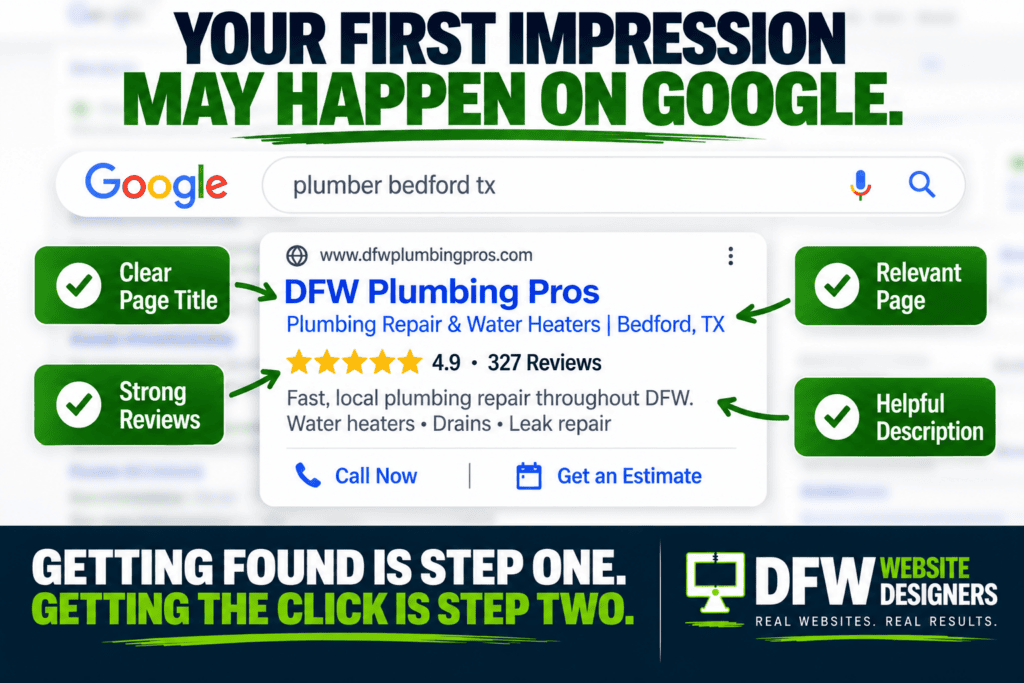
Those aren’t traditional two- or three-word Google searches. They’re questions. For AI to connect your business with those questions, it needs information it can understand. That information often comes from your website.
Pretty Isn’t Enough Anymore
We’ve built more than 1,250 websites during our 17+ years in business, and we’ve seen website design trends come and go. Remember giant homepage sliders? Or websites where practically everything was crammed onto one page? Or when everyone wanted a video playing automatically in the background? Some of those ideas looked impressive.
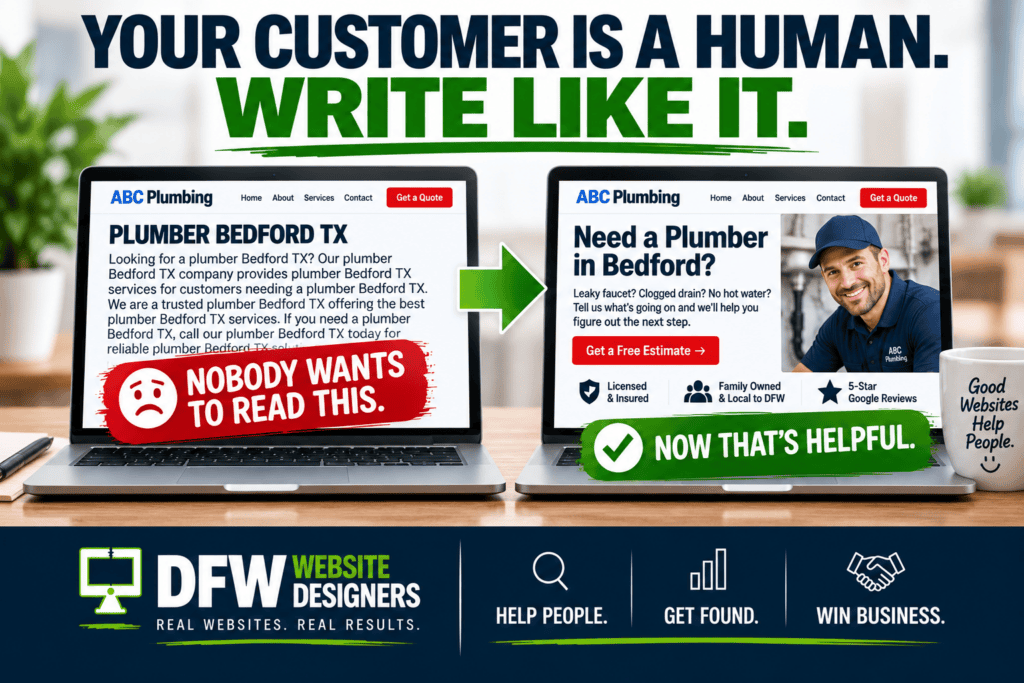
But a website isn’t an art project. It’s a business tool. A gorgeous website that doesn’t clearly explain your services isn’t doing its job. Neither is a website that has a beautiful homepage but gives Google and AI very little information about what the company actually does. That’s why modern web design needs substance behind the appearance.
Good Web Design Creates Good Structure
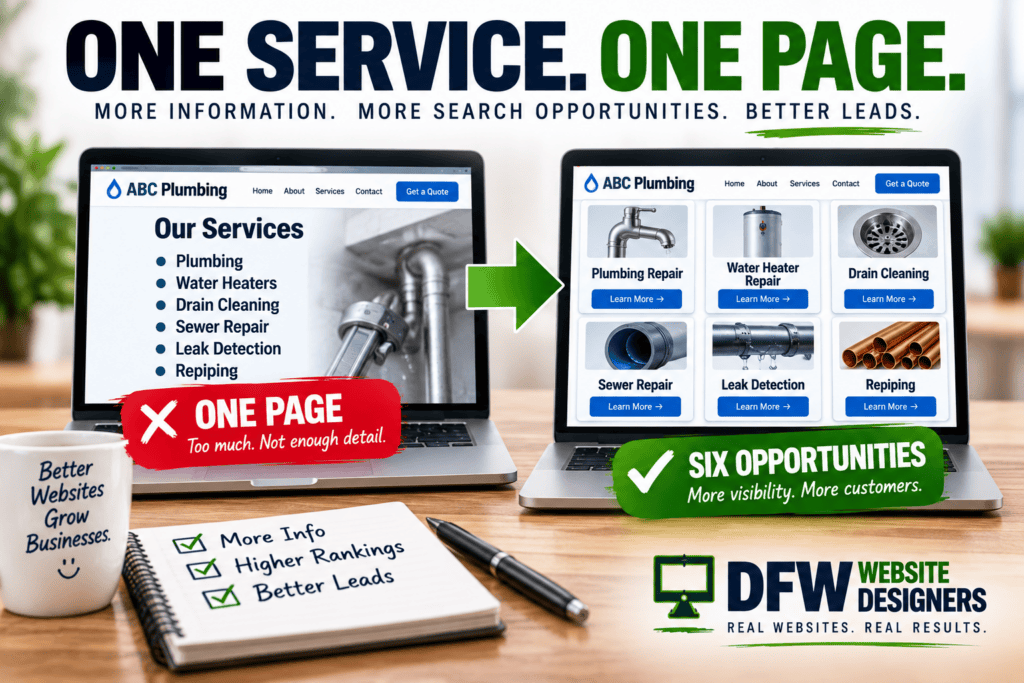
Imagine you’re a plumber offering: Water heater repair, Drain cleaning, Sewer repair, Leak detection & Emergency plumbing. We could put five little boxes on the homepage listing those services. That might look nice. But what if each service had its own useful page? Now someone interested in water heater repair can land directly on a page explaining water heater repair.
Google can understand that you provide water heater repair. AI systems have more information available when someone asks about water heater problems. And the customer doesn’t have to hunt around your website trying to figure out whether you offer the service. That’s good SEO. That’s good AI optimization. But most importantly… That’s good web design.
The Same Goes for Local Search
Local businesses need to make it obvious where they work. If you serve Bedford, Hurst, Euless, Colleyville, Grapevine, Fort Worth and surrounding DFW communities, don’t make your customers—or search technology—guess. Useful city and service-area content can help explain the geographic footprint of your business. But there’s an important distinction.
Creating 50 nearly identical pages and simply replacing “Bedford” with “Euless” isn’t particularly useful. A strong local page should provide meaningful information about the service you offer in that community. We want pages built for people first, with search visibility as a benefit.
Answer Questions Your Customers Actually Ask
This may be one of the easiest AI-search improvements a small business can make. Think about the questions you answer every week. “How much does it cost?” “How long does it take?” “Do you serve my city?” “Do you offer financing?” “Can you do this type of job?” “What’s the difference between these two services?” “Do I need to replace it or can it be repaired?”
Every one of those could become website content. Maybe it’s an FAQ. Maybe it’s a section on a service page. Maybe the question deserves an entire blog post. Your salespeople, receptionist and technicians probably already know dozens of great content topics because they’re answering these questions every day. Put those answers online.
Don’t Design a Website for a Robot
There’s an important warning here. As AI search becomes the latest marketing buzzword, we’re going to see plenty of strange ideas about how websites should be built “for AI.” Don’t forget the customer.
Google itself says the fundamentals of SEO remain important for its generative AI search experiences and recommends useful, original, people-first content rather than chasing special AI-search tricks. That’s an important lesson. You don’t need an ugly website stuffed with keywords and thousands of robotic pages.
You need a website that’s easy to understand. Clear design. Clear navigation. Clear services. Clear locations. Useful content. Real answers. Easy ways to contact you. Funny enough, that’s what a good business website should have been doing all along.
AI Doesn’t Replace Great Web Design
AI is changing how people discover businesses. Google is incorporating more generative AI into Search. Customers are asking longer and more conversational questions. AI assistants are increasingly becoming part of how people research products, companies and services.
But none of that makes your website less important. We believe it makes the website more important. Your website is one of the places where you control the story about your business. It’s where you explain your services. It’s where you establish your locations. It’s where you demonstrate experience. It’s where you answer questions. It’s where you show examples of your work. It’s where you give both customers and search technology information about who you are.
Build for Humans. Make It Easy for AI.
That’s probably the simplest way we can describe our approach going forward. Design the website for the customer. Then make sure the structure, content and technical foundation make that information easy for search engines and AI systems to discover and understand. You shouldn’t have to choose between a website that looks great and one that’s built for modern search. You need both. That’s where AI search meets great web design.
And at DFW Website Designers, that’s exactly where we think website development is heading. If your website was built several years ago, it might be time to ask a new question: Was my website built for the way customers search today—or the way they searched five years ago? DFW Website Designers helps businesses throughout Dallas-Fort Worth build, redesign and optimize websites for today’s customers, traditional search engines and the rapidly changing world of AI-powered search.
Ready to see if your website is search-ready? Give us a call at 817-247-6003.