It’s Sunday. You’re off. Or at least… you’re supposed to be off. Maybe you’re at church. Maybe you’re having lunch with the family. Maybe you’re watching football. Maybe you’re taking the dog for a walk. Maybe you’re sitting on the couch with a cup of coffee doing absolutely nothing. Which, by the way, is allowed. But while you’re relaxing, something interesting may be happening.
Someone in Bedford searches: water heater repair near me
Someone in Grapevine searches: commercial electrician
Someone in Arlington searches: roof repair
Someone in Fort Worth searches: website designer
Someone in Euless searches: AC repair
Your office may be closed. Your employees may be home. Your phone may not be answered until Monday. But your potential customers haven’t stopped having problems just because it’s Sunday. That’s why one of the most important things you can build for your business is something that doesn’t care what day it is.
YOUR WEBSITE.
A good website doesn’t take Sundays off. And it shouldn’t.
Your Website Should Be Your Hardest-Working Employee
Think about this for a minute. You probably have business hours. Maybe: Monday-Friday 8:00 AM-5:00 PM But your website doesn’t need business hours. It can work: Monday morning. Tuesday afternoon. Wednesday at lunch. Thursday night. Friday at 11:00 PM. Saturday morning. Sunday afternoon. Christmas morning. At 2:17 AM when someone suddenly realizes their air conditioner isn’t working.
Your website doesn’t need: Vacation. Lunch. Coffee. Overtime. Health insurance. A company truck. A corner office. Or a motivational meeting Monday morning. It just keeps working. At least…
IT SHOULD.
Unfortunately, Some Websites Aren’t Doing Much Work
There are plenty of websites technically online 24 hours a day. That doesn’t mean they’re actually doing anything. Imagine hiring an employee who sits at the front desk all day and says: “Welcome to ABC Company.”
Then nothing else. Customer: “What do you guys do?” Employee: “Welcome to ABC Company.” Customer: “Do you repair water heaters?” Employee: “Welcome to ABC Company.” Customer: “How much does it cost?” Employee: “Welcome to ABC Company.” Customer: “Can I schedule an appointment?” Employee: “Please call during normal business hours.”
You’d fire that employee. Yet that’s basically what some websites do.
An Online Brochure Isn’t Enough Anymore
Years ago, simply having a website was impressive. “Look! We have a website!” Great. So did about twelve other businesses. Today, customers expect more. A website shouldn’t simply say: We’re ABC Company. Here’s our logo. Here’s our phone number. Thanks for visiting.
A modern business website should help move someone through a decision.
From:
“WHO ARE THESE PEOPLE?”
to:
“THESE PEOPLE MAY BE ABLE TO HELP ME.”
to:
“I TRUST THEM.”
to:
“I’M GOING TO CONTACT THEM.”
That’s work. And your website can do it while you’re watching football.
So What Should Your Website Be Doing on Sunday?
Let’s walk through it. A potential customer has a problem. We’ll call him: Mike. Because Mike seems like a perfectly reasonable name for a guy with a broken water heater on Sunday. Mike walks into the garage. There’s water. That’s generally not where Mike likes his water. Mike looks at the water heater. Mike says something I probably shouldn’t put in a business blog.
Then he grabs his phone. Your website’s Sunday shift just started.
JOB #1: GET FOUND
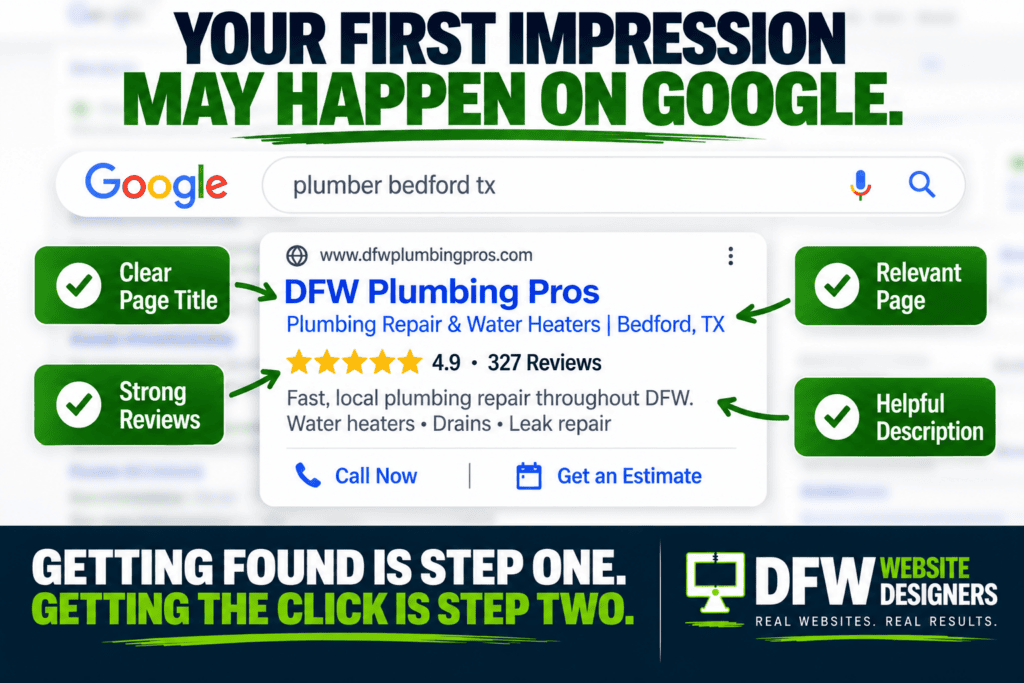
Mike searches: water heater repair Bedford TX
Your website can’t help Mike if Mike can’t find it. This is where: SEO. Google Business Profile. Service pages. Local content. Useful blog posts. City/service-area content. Technical website structure. Reviews. All begin working together. Friday’s lesson was:
GETTING FOUND IS STEP ONE. GETTING THE CLICK IS STEP TWO.
Your website’s job starts before Mike ever reaches the homepage. He has to discover you.
JOB #2: EARN THE CLICK
Mike sees several companies. Company A. Company B. Company C. You. Maybe some ads. Maybe map results. Maybe directories. Mike is choosing. He notices: A relevant page title. A recognizable business name. Strong reviews. A description that sounds like his problem. He clicks. Congratulations.
Your website just won its first little Sunday battle. But we’re not done.
JOB #3: TELL MIKE HE’S IN THE RIGHT PLACE
Mike lands on your page. What does he need immediately? Not your company history. Not a giant slideshow. Not: “Leveraging innovative solutions to exceed customer expectations.” Mike has water on his garage floor. He needs:
WATER HEATER REPAIR
Serving Bedford & Northeast Tarrant County Perfect. Mike knows: Right service. Right area. Potentially right company. Remember Monday’s lesson?
YOU HAVE 5 SECONDS. DOES YOUR WEBSITE MAKE SENSE?
Mike shouldn’t have to figure you out. Make it obvious.
JOB #4: ANSWER MIKE’S QUESTIONS
Now Mike starts scrolling. He’s wondering: Can you fix this today? Do you repair his type of water heater? Do you replace them too? What brands do you service? How long does replacement take? Does this mean he needs a new unit? Is the leaking water dangerous? Should he shut something off? How much might this cost? Do you serve Bedford? Are you available Monday?
Your service page should answer the questions you know customers ask. That’s why Wednesday’s lesson was:
YOUR CUSTOMER IS A HUMAN. WRITE LIKE IT.
Write for Mike. Not an algorithm. Mike has a problem. Help him understand it.
JOB #5: BUILD TRUST
Mike doesn’t know you. This is important. You know your company. Your employees know your company. Your existing customers know your company. Mike does not. From his perspective, you’re: Some company on the internet. Now your website needs to answer:
“WHY SHOULD I TRUST THESE PEOPLE?”
This is where Thursday’s lesson comes in:
DON’T TELL ME YOU’RE GREAT. PROVE IT.
Show Mike: ⭐⭐⭐⭐⭐ Reviews 17+ Years in Business Licensed & Insured Real project photos. Real customer testimonials. Professional certifications. Team photos. Warranty information. Actual service areas. Real contact information. Case studies where appropriate. Mike is looking for evidence. Give it to him.
JOB #6: EXPLAIN WHAT HAPPENS NEXT
Mike likes what he sees. Now what? This is where websites sometimes become strangely shy. They spend five pages convincing someone to hire them… and then make the customer search for a way to actually do it.
Don’t do that. Tell Mike: Call Now or: Request Service or: Get a Free Estimate or: Schedule an Appointment Whatever the next logical step is. Make it obvious.
JOB #7: CAPTURE THE LEAD
Mike fills out the form: Name: Mike Phone: 817-555-XXXX Service: Water Heater Repair Message: Water heater leaking in garage. Please call me Monday morning. CLICK.
NEW LEAD.
Sunday. 2:47 PM. You’re watching the Cowboys. Your website is working. That’s exactly what we want.
Your Website Doesn’t Have to Close the Entire Sale
This is important. Your website isn’t necessarily supposed to replace you. For many businesses, that’s impossible. A website can’t: Inspect Mike’s water heater. Walk his property. Understand every detail of a complicated legal case. Measure his roof. Diagnose his transmission. Design his entire remodeling project. Understand every requirement of his business. But it can move Mike forward.
From: Stranger to: Visitor to: Interested prospect to: Lead. Then Monday morning… a human takes over. That’s a good system.
Your Website Is the Night Shift
I like thinking about websites this way. Your employees work the day shift. Your website works the night shift. And weekends. And holidays. It answers basic questions. Explains services. Shows examples. Builds trust. Collects information. Routes customers. Creates opportunities. It’s the employee who never says: “Can this wait until Monday?”
A Website Should Answer Questions Before the Phone Rings
Here’s another benefit. Imagine Monday morning.
Customer #1 calls: “Do you guys repair tankless water heaters?”
Customer #2: “Do you serve Grapevine?”
Customer #3: “Are you licensed?”
Customer #4: “Do you work on commercial properties?”
Customer #5: “How do I request an estimate?”
Now imagine your website answers all five questions. Maybe those customers still call. That’s fine. But now the conversation starts further along. Instead of: “Do you do this?” it becomes: “I saw on your website that you do this. I’d like to schedule.” That’s a much better phone call.
Good Content Pre-Sells the Customer
This is one of the most overlooked benefits of website content. The customer can educate themselves before contacting you. They read: Your service page. An FAQ. A blog post. A case study. Your About page. Reviews. Maybe several pages. By the time they contact you, they may already understand: What you do. How you do it. Why you’re different. Whether you serve them. What happens next.
That’s not just traffic. That’s sales support.
Service Pages Work While You Sleep
Tuesday we talked about:
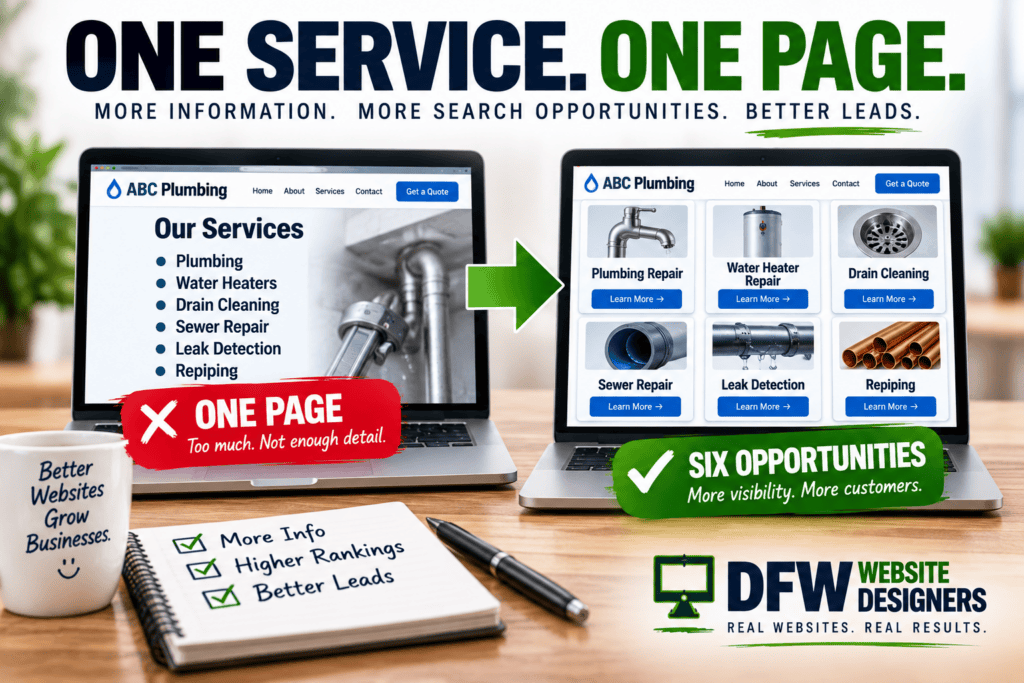
ONE SERVICE. ONE PAGE.
This is exactly why. Imagine you offer six services. Instead of one generic Services page, you have six useful pages. Each page can: Explain that service. Answer questions. Show photos. Display relevant reviews. Address customer concerns. Explain the process. Target an appropriate call to action. Potentially create another search opportunity.
Now your website has six specialized salespeople instead of one employee saying: “Yeah, we do a bunch of stuff.”
Blog Posts Work Weekends Too
Maybe Mike isn’t ready to hire someone yet. Maybe he searches: Why is my water heater leaking from the bottom? You have an article answering that question. Mike reads it. Now he knows: Possible causes. What he should do immediately. When repair may be possible. When replacement might make more sense.
At the bottom: Need help with a leaking water heater in Bedford? Contact ABC Plumbing. Your blog just introduced Mike to your company. That’s why useful content matters.
Reviews Work While You’re Gone
Your customers are selling for you too. Imagine Mike sees:
⭐⭐⭐⭐⭐
“Our water heater started leaking Sunday evening. ABC Plumbing responded first thing Monday morning and had the new unit installed that afternoon.”
That’s incredibly relevant. You didn’t write it. A customer did. That’s why reviews are such powerful proof. They’re working Sunday too.
Photos Work While You’re Gone
Real project photos tell stories. They say: We’ve done this before. This is our work. These are our people. This is our equipment. These are actual projects. These are actual customers.
For many service businesses, real photos may communicate more credibility than paragraphs of copy.
Your Contact Form Better Be Working on Sunday
Now for the boring-but-important part. Mike finally decides: “I’m contacting these people.” He fills out the form. And the form doesn’t work.
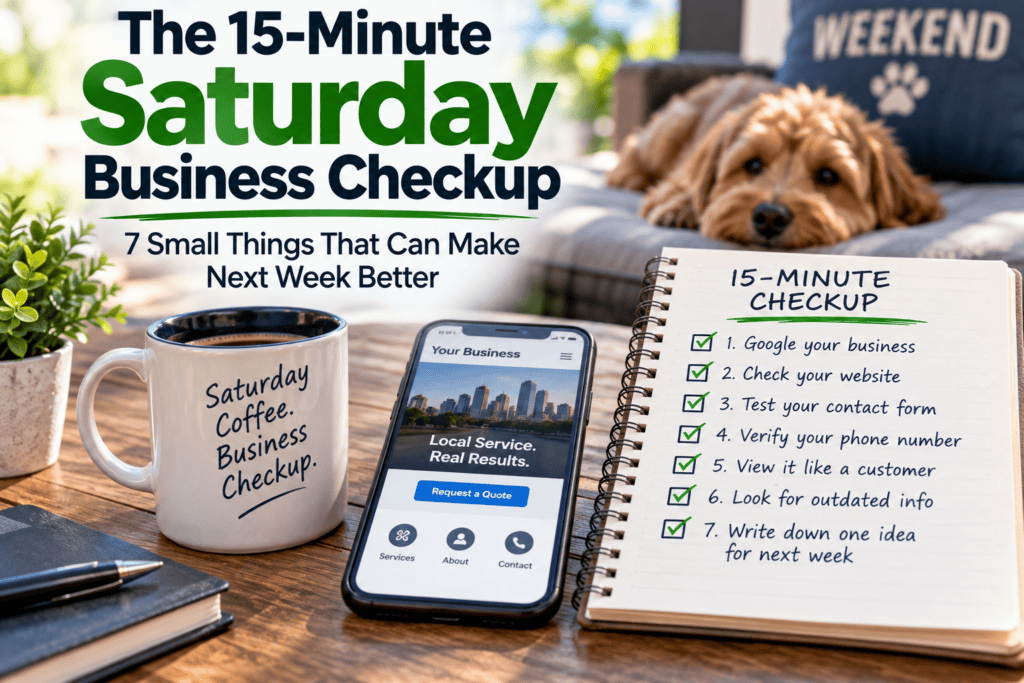
That’s why yesterday’s 15-Minute Saturday Business Checkup included:
TEST YOUR CONTACT FORM.
Forms break. Email routing changes. Plugins change. Spam filters change. Websites get updated. Test them periodically. Because a broken contact form is basically an employee taking leads and throwing them in the trash.
Your Phone Number Should Work Too
Same thing. Mobile customer taps: CALL NOW Wrong number. Old number. Number isn’t clickable. Nobody answers and there’s no voicemail. That’s a problem. Your website can only work 24/7 if the machinery behind it works too.
What Happens After the Sunday Lead?
Here’s where we need to be careful. Your website did its job. Mike submitted the form Sunday at 2:47 PM. Monday morning at 8:03 AM… someone needs to do something. Remember our earlier lesson:
YOUR WEBSITE GENERATED A LEAD. NOW HOW FAST ARE YOU RESPONDING?
A website can’t fix a bad follow-up process. If Mike contacts: You. Competitor A. Competitor B. and Competitor A responds first… your beautiful website may have created a lead for somebody else. Not literally. But you get the point. Marketing and sales have to connect.
Automatic Confirmation Helps
When Mike submits a form, give him immediate confirmation. Something like:
Thanks, Mike! We’ve received your request. Our team will contact you during business hours. If this is an emergency, call XXX-XXX-XXXX.
Now Mike knows: The form worked. You received it. What happens next. When he should expect contact. That’s much better than:
Submission successful.
Very warm.
Your Website Should Set Expectations
This is especially important after hours. If you don’t answer Sunday: Say so. If emergency service is available: Explain it. If someone will respond Monday morning: Say that.
If appointments can be booked online: Provide the option. Clear expectations build trust.
A Great Website Gives the Owner Some Freedom
Here’s where today’s Sunday message gets bigger. Why do we build systems? So everything doesn’t depend on the owner every second. A good website helps answer questions without you. Generates leads without you. Shows work without you. Explains services without you. Collects customer information without you. Builds credibility without you.
That doesn’t mean the business runs itself. But it means:
YOU DON’T HAVE TO PERSONALLY DO EVERYTHING.
That’s valuable.
Small-Business Owners Need That
Because if you’re like most small-business owners, you’re already wearing enough hats. Owner. Salesperson. Customer service. Manager. Bookkeeper. Marketer. Problem solver. IT department. Sometimes janitor.
If your website can take a few things off your plate… let it.
Stop Thinking of Your Website as an Expense
Businesses sometimes look at a website as: A bill. Hosting. Maintenance. Redesign. SEO. Content. Support. But ask another question:
WHAT IS THIS ASSET DOING FOR THE BUSINESS?
Is it: Generating inquiries? Helping customers find you? Answering repetitive questions? Supporting sales? Building credibility? Recruiting employees? Explaining services? Showing projects? Supporting advertising? Helping existing customers? If yes, it’s doing work. That’s the better way to evaluate it.
But It Has to Be Maintained
Even the hardest-working employee needs support. Your website needs: Updates. Backups. Security. Content updates. Service updates. Form testing. Mobile checks. Performance checks. Review updates. New photos. Technical maintenance. Remember yesterday?
WEBSITES NEED ATTENTION. NOT OBSESSION.
That’s still true.
What Should Your Website Accomplish While You’re Off?
Here’s the Sunday test. Open your website and ask:
1. CAN A CUSTOMER FIND ME?
Search visibility and local presence.
2. CAN THEY IMMEDIATELY UNDERSTAND WHAT I DO?
Clear messaging.
3. CAN THEY FIND THEIR SPECIFIC SERVICE?
Good navigation and individual service pages.
4. CAN THEY GET THEIR QUESTIONS ANSWERED?
Helpful content.
5. CAN THEY DECIDE WHETHER TO TRUST ME?
Reviews, experience and proof.
6. CAN THEY EASILY CONTACT ME?
Phone, form, booking or appropriate CTA.
7. WILL I ACTUALLY RECEIVE THE LEAD?
Working forms and notifications. If the answer to all seven is: YES excellent. Go back to the football game.
The Goal Isn’t More Website Visitors
This connects to something we’ve talked about before. A thousand visitors don’t pay the bills. Customers do. The goal isn’t simply: MORE TRAFFIC. The goal is: MORE OF THE RIGHT PEOPLE MOVING TOWARD BECOMING CUSTOMERS.
That’s why the website needs to do more than sit there.
Your Website Should Move People Forward
Think about the stages:
GET FOUND -> EARN THE CLICK -> ANSWER QUESTIONS -> BUILD TRUST -> MAKE THE NEXT STEP OBVIOUS -> CAPTURE THE LEAD -> FOLLOW UP -> WIN THE CUSTOMER
Every stage matters. If one breaks, opportunities leak out.
Sunday Is Actually a Great Test
Why? Because you’re not there. That’s the point. If your website only works when you’re personally answering every question… it’s not doing enough. Ask: “What happens if someone finds us at 2:47 Sunday afternoon?”
Can they understand the business? Can they research? Can they build confidence? Can they contact you? If so: Your website is working.
Your Website Should Work Even When You Aren’t
That’s today’s message. You deserve a Sunday. Your family deserves some of your Sunday. Your dog probably thinks she deserves all of Sunday. And your business? It can keep working. That’s what good systems do.
At DFW Website Designers, we’ve spent 17+ years building websites for businesses throughout DFW. We’ve built 1,250+ websites and help manage 550+ websites. And the goal isn’t simply to make something pretty. We want websites that: GET FOUND. BUILD TRUST. ANSWER QUESTIONS. CAPTURE LEADS. Because a website shouldn’t simply exist.
IT SHOULD WORK.
Monday. Tuesday. Wednesday. Thursday. Friday. Saturday. And yes…
SUNDAY.
So enjoy the coffee. Enjoy the family. Enjoy the game. Take the dog for a walk. And hopefully, sometime this afternoon, your phone lights up:
NEW LEAD — 2:47 PM.
Your website: “Don’t worry, boss. I’ve got this.” DFW Website Designers Real Websites. Real Results. Your Website Should Work Even When You Aren’t.