I have some exciting news. I just checked the internet, and apparently… EVERY BUSINESS IS THE BEST. Seriously. Spend five minutes visiting business websites and you’ll see: Unmatched Quality, Exceptional Service, Industry-Leading Solutions, Trusted Professionals, Premier Provider, Best-in-Class, Customer-Focused Excellence, & Your #1 Choice.
Apparently, nobody on the internet provides: “Pretty Decent Service Most of the Time.” Everybody is amazing. Which creates a problem. If everybody says they’re the best…
WHY SHOULD YOUR CUSTOMER BELIEVE YOU?
At DFW Website Designers, we’ve spent 17+ years building more than 1,250 websites, and today we help manage 550+ websites. Notice what I just did. I didn’t say:
“We’re DFW’s premier industry-leading website experts delivering unmatched digital excellence.”
I gave you numbers. 17+ years. 1,250+ websites. 550+ websites under management. You can decide what those facts mean. That’s today’s lesson:
DON’T TELL ME YOU’RE GREAT. PROVE IT.
Customers Have Heard It All Before
Imagine you’re looking for a roofer. You visit Company A. Homepage:
“DFW’s Trusted Roofing Experts.”
Company B:
“Quality Roofing You Can Trust.”
Company C:
“Your Trusted Local Roofing Professionals.”
Company D:
“The Roofing Experts You Can Trust.”
At this point, the word TRUST is doing a tremendous amount of unpaid labor. But has anyone actually demonstrated trustworthiness? That’s the opportunity. Instead of merely saying: TRUST US show customers: WHY.
Specific Proof Beats Generic Promises
Let’s compare.
Version #1
We provide exceptional service and unmatched quality.
Okay. According to whom? Now:
Version #2
⭐⭐⭐⭐⭐ 4.9 Google Rating
327 Customer Reviews
Serving DFW Since 2009
Licensed & Insured
1,800+ Projects Completed
That’s different. The first version is a claim. The second gives the customer information they can evaluate. That’s what today’s social-media square means by:
SPECIFIC PROOF BEATS GENERIC PROMISES.
Marketing Claims Aren’t Necessarily Bad
Before every marketing writer throws something at me… there’s nothing inherently wrong with saying: Quality Service or: Customer Focused or: Experienced Professionals Those statements can support your message. The problem comes when those statements are all you’ve got. If you say:
“We’re experienced.”
follow it with: Serving DFW Since 2009. If you say:
“Customers love us.”
show: 327 Google Reviews. If you say:
“We know website design.”
show: 1,250+ Websites Built. If you say:
“We’re local.”
show: Bedford, Texas. Serving DFW businesses for 17+ years. Claim. Then proof. Much stronger.
Customers Are Looking for Risk
Here’s something important about the psychology of your website. Customers aren’t only asking: “Can this company help me?” They’re also asking:
“WHAT COULD GO WRONG?”
Think about hiring: A roofer. An attorney. A remodeling contractor. An insurance agency. A moving company. A website designer. A mechanic. A plumber. The customer is taking a risk. Will you show up? Will you answer the phone? Will the price change? Will the work be good? Will you disappear after the deposit? Will you damage something? Will you finish? Will you stand behind the work? Trust signals help reduce perceived risk.
Trust Is Especially Important Online
If someone walks into your physical business, they get information automatically. They see: The building. Employees. Equipment. Customers. Products. Vehicles. Certificates on the wall. Maybe awards. They get a sense: This is a real business.
Online, we have to recreate some of that confidence digitally. Your website needs to communicate: We’re real. We’re established. We know what we’re doing. Other people have trusted us. Here’s evidence.
Proof #1: Customer Reviews
Let’s start with the obvious one.
REVIEWS.
Reviews are powerful because they’re not you talking about yourself. They’re customers talking about you. Google encourages businesses to engage with reviews and notes that positive reviews and helpful responses can help a business stand out. Google Business Profile Review Guidance
If you have strong reviews: USE THEM. Don’t hide them all on: /testimonials/ Show them where decisions happen. Homepage. Service pages. Landing pages. Contact page. Near calls to action.
Don’t Just Show Five Stars
This: ⭐⭐⭐⭐⭐ is nice. This: ⭐⭐⭐⭐⭐ 4.9 Google Rating — 327 Reviews is stronger.
Why? Specificity. The customer now has context. Five stars from: 3 reviews is different from: 327 reviews. Again: Give the customer information. Let them decide what it means.
Use Actual Review Language
Suppose your website says:
“We provide excellent communication.”
Okay. Now imagine a customer review says:
“They answered every question, kept us updated throughout the project and always returned our calls.”
Which is more convincing? The second. Because someone experienced it. Your customers often write better marketing copy than your marketing company. Use it.
Proof #2: Years in Business
Experience is another powerful trust signal. Instead of: Experienced Professionals say: Serving DFW Since 2009 or: 17+ Years in Business That’s tangible. The customer can interpret that as: These people have been around. They’ve probably encountered my problem before. They didn’t open yesterday. Again, we’re reducing uncertainty.
Don’t Hide Your History on the About Page
Businesses often have incredible stories buried five clicks deep. Homepage:
WELCOME TO ABC COMPANY
About page:
Founded in 1987…
Wait. You’ve been doing this for nearly 40 years? Why wasn’t that on the homepage? If longevity matters in your industry, use it as a trust signal. Serving North Texas Since 1987 That’s worth showing.
Proof #3: Number of Customers or Projects
Numbers can be powerful. Examples: 10,000+ Service Calls Completed, 2,500+ Roofs Installed, 1,250+ Websites Built, 750+ Families Served, 300+ Commercial Projects & 50,000+ Orders Shipped. Only use numbers you can reasonably support. But if you’ve accumulated meaningful experience… don’t hide it.
Avoid Fake Precision
Don’t do this: 12,847 Happy Customers unless you actually track that. Round numbers are perfectly fine. 12,000+ Customers Served is believable and understandable. The point isn’t to manufacture impressive statistics. The point is to surface real ones.
Proof #4: Licenses and Certifications
Depending on the industry, credentials matter enormously. Show: Licenses. Certifications. Professional designations. Manufacturer certifications. Insurance. Bonding. Specialized training. Industry credentials. But here’s an important point: Explain them. Your customer may not know what: ABC-XYZ Level IV Certified means. Tell them why it matters.
Certified installers trained to manufacturer specifications.
Now the credential has context.
Proof #5: Real Project Photos
This one is huge for home-service businesses. If you’re a: Roofer. Remodeler. Landscaper. Painter. Pool company. Concrete contractor. Flooring installer. Fence company. Builder. Show the work. Not just stock photography.
YOUR WORK.
Before. After. During. Completed. A gallery full of real projects says: We’ve actually done this. That’s proof.
Before-and-After Photos Are Especially Powerful
Customer sees: Before: terrible backyard. After: beautiful outdoor living area. You don’t need a paragraph saying:
“We provide transformative outdoor solutions.”
We can see it. Visual evidence is incredibly efficient. Let the project demonstrate the result.
Proof #6: Case Studies
For professional services, B2B companies and larger projects, case studies can be even stronger. A basic structure:
THE PROBLEM
What did the customer need?
THE SOLUTION
What did you do?
THE RESULT
What changed? Maybe: Traffic increased. Costs decreased. Response time improved. Leads increased. Project finished early. Downtime decreased. Revenue increased. Process became easier. Again: Specific results beat: “We deliver results.”
Don’t Invent Results
This should be obvious. But let’s say it anyway. Don’t claim: “Increased revenue 237%” because it looks good on a graphic. If you don’t know… don’t say it. Credibility takes years to build and seconds to destroy. Proof only works if it’s real.
Proof #7: Real People
Who works at your company? Show them. Owners. Leadership. Technicians. Advisors. Project managers. Customer-service team. People like knowing who they’re about to work with. A real team photo can communicate: We’re an actual organization.
Especially compared with a website containing 14 stock-photo models who apparently work simultaneously as: Plumbers. Accountants. Doctors. Roofers. And financial advisors. Busy people.
Your About Page Should Contain Evidence Too
Don’t make your About page:
“At ABC Company, we’re passionate about excellence and committed to exceeding expectations.”
Tell me something. When did you start? Why? Who’s involved? What do you specialize in? How many people work there? What communities do you serve? What have you accomplished? What makes your process different? What have you learned? Stories build trust because they’re specific.
Proof #8: Physical Location
For local businesses, a real location can matter. Show: City. Address when appropriate. Service area. Phone number. Map. Office photos. Customers want to know: Are you really local?
Google’s Business Profile guidance also emphasizes maintaining complete and accurate business information, including details that help customers understand and connect with the business. Google Business Profile Guidelines Don’t make your location a mystery.
Proof #9: Professional Associations
Membership can help establish legitimacy. Maybe: Local Chamber of Commerce. Industry associations. Better Business Bureau. Professional organizations. Manufacturer programs. Community groups. But don’t create a NASCAR homepage with 47 logos fighting for attention.
Use associations that actually matter to your customer. And make sure the membership is current.
Proof #10: Awards
Awards can help. Especially recognizable ones. But context matters. Instead of: 🏆 AWARD WINNING say: 2026 Readers’ Choice — Best HVAC Company Specific. Verifiable. Understandable. Also… if the award is from 2004… maybe don’t make it the hero section.
Proof #11: Guarantees and Warranties
If your company offers meaningful guarantees, communicate them clearly. Examples: Workmanship warranty. Satisfaction guarantee. Product warranty. Response guarantee. Price guarantee. But explain: What’s covered? For how long? What are the limitations? A vague: 100% SATISFACTION GUARANTEED sounds nice. A clear explanation sounds credible.
Proof #12: Show Your Process
A defined process can itself build trust. For example: 1. Request an Estimate 2. Meet With Our Team 3. Receive Your Proposal 4. Schedule the Work 5. Project Completed Now the customer knows what happens. Uncertainty creates anxiety. Process creates confidence.
Proof #13: Show Real Work in Progress
Finished projects are great. So is behind-the-scenes work. Your team on-site. Equipment. Installation. Planning. Delivery. Meetings. Training. Production. Customers see: These people actually do what they say they do. That’s particularly useful on social media.
Proof #14: Content Itself Can Demonstrate Expertise
Yesterday we talked about writing for humans. Helpful content is also proof. Suppose you’re comparing two HVAC companies. Company A:
“We’re HVAC experts.”
Company B has written useful explanations about: Why AC systems freeze. When to repair versus replace. SEER ratings. Common thermostat problems. Indoor air quality. Maintenance. Which company demonstrates more knowledge? The content itself becomes evidence. You don’t have to say: WE’RE EXPERTS. Show expertise.
Expertise Is Better Demonstrated Than Announced
This is worth repeating. Anyone can type:
EXPERTS.
It’s six letters. Takes about two seconds. Actually demonstrating expertise requires: Useful answers. Experience. Examples. Knowledge. Results. Customer feedback. Credentials. That’s harder. Which is exactly why it’s more convincing.
Specificity Makes Marketing Believable
Compare:
GENERIC
Fast Service
SPECIFIC
Same-Day Appointments Available
GENERIC
Highly Experienced
SPECIFIC
Serving DFW Since 2009
GENERIC
Customers Love Us
SPECIFIC
4.9 Stars From 327 Google Reviews
GENERIC
Trusted by Businesses
SPECIFIC
550+ Websites Under Management
GENERIC
We Build Websites
SPECIFIC
1,250+ Websites Built
Which column feels stronger? Exactly.
Specific Doesn’t Always Mean Numerical
You don’t need a giant number for everything. Proof can also be: A photograph. A testimonial. A credential. A client logo. A case study. A named project. A video. A demonstration. A portfolio. A sample.
A documented process. The principle is simply: SHOW ME SOMETHING.
Don’t Turn Your Homepage Into a Trophy Case
There’s a balance. You don’t need: 37 reviews. 19 badges. 12 awards. 8 certifications. 6 association logos. 4 counters. 3 guarantees. and a partridge in a pear tree. Choose your strongest proof. Make it easy to scan. Then distribute additional evidence throughout the website.
Put Proof Near the Decision
This is important. Where does a customer need reassurance? Near: CALL NOW, REQUEST A QUOTE, SCHEDULE A CONSULTATION, BUY NOW, & CONTACT US. Suppose a visitor is about to request a roof estimate. Right there, show: ⭐⭐⭐⭐⭐ 4.9 Google Rating, Licensed & Insured, 25-Year Workmanship Warranty Those signals may help reduce hesitation. Trust belongs near the decision.
Match the Proof to the Page
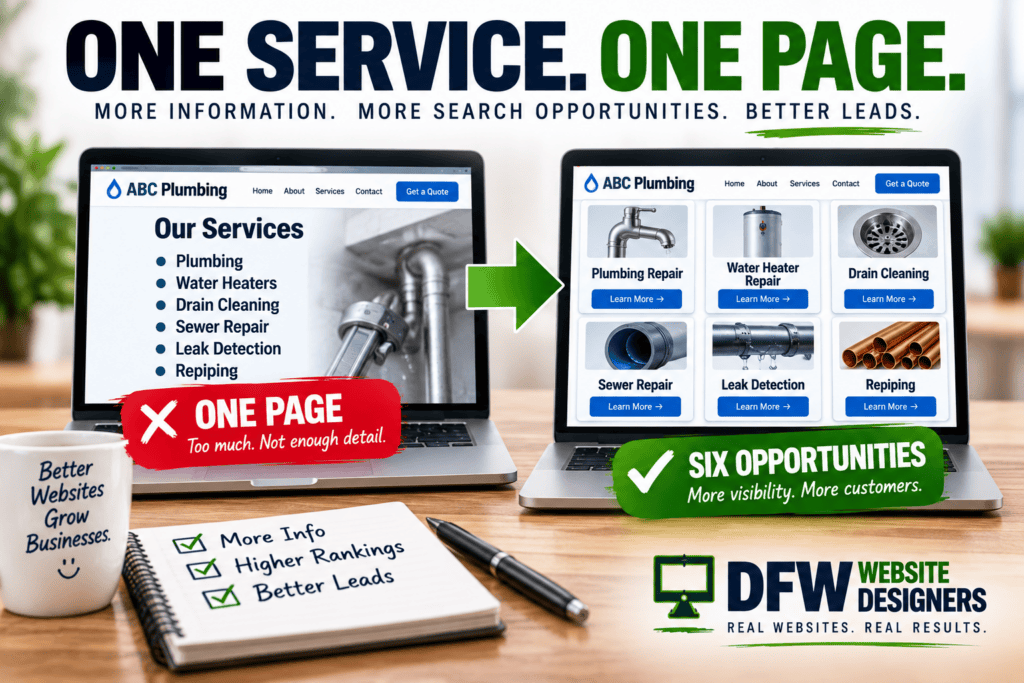
Remember Tuesday’s lesson: ONE SERVICE. ONE PAGE. We can make proof more specific too. Water heater page? Use a water-heater review. Roof replacement page? Show roof projects. Commercial insurance page? Use a commercial-client testimonial. Website redesign page? Show before-and-after websites.
The more relevant the proof, the stronger it becomes.
Testimonials Shouldn’t All Sound the Same
Beware of testimonials like:
“Great company!” — John D.
“Amazing service!” — Mary S.
“Highly recommend!” — Bob T.
They’re positive. But not particularly informative. A stronger testimonial explains: What problem existed. What the company did. What stood out. What result occurred. Specific testimonials feel real because real experiences contain details.
Video Testimonials Can Be Powerful
If a customer is willing, video can be even stronger. You see: A real person. Speaking naturally. Describing an actual experience. It doesn’t need Hollywood production. Authenticity often matters more.
Thirty seconds of a happy customer talking about a real project can outperform an entire page of marketing adjectives.
Your Google Reviews and Website Should Support Each Other
Customers may bounce between: Your website. Google Business Profile. Facebook. LinkedIn. Review sites. They aren’t evaluating these channels separately. They’re evaluating:
YOU.
Consistency matters. Company name. Address. Phone. Services. Photos. Branding. Reviews. The whole online presence should reinforce the same story.
Don’t Fake Social Proof
No fake reviews. No fake counters. No fake customer logos. No fake awards. No fake testimonials. No: “10,000+ Happy Customers” when you’ve served 84. Short-term cleverness isn’t worth long-term credibility. If you’re newer, that’s okay. Use the proof you actually have.
What If You’re a New Business?
Great question. You may not have: 20 years. 500 reviews. 10,000 customers. That’s fine. Use different proof. Owner’s prior experience. Certifications. Training. Portfolio. Professional associations. Guarantees. Real photos. Transparent process. Detailed expertise. Early customer testimonials. Responsiveness. Your competitive advantage.
Every business starts at zero reviews. Trust can still be built honestly.
What If You Don’t Have Enough Proof?
Then today’s marketing assignment isn’t: MAKE SOME UP. It’s:
START COLLECTING IT.
Ask satisfied customers for reviews. Photograph projects. Document results. Build case studies. Update team bios. Gather certifications. Record testimonials. Track meaningful statistics. Take before-and-after photos. Keep a project count. Build the evidence over time. Proof is an asset.
Your Sales Team Knows What Proof Matters
Ask:
“What makes customers finally say yes?”
Maybe they always ask: Are you insured? How long have you been around? Have you done a project like mine? Can I speak with a customer? What happens if something goes wrong? Do you guarantee the work? Great. Your website should answer those questions before the call.
The Thursday Trust Test
Here’s today’s assignment. Open your homepage. Find every statement that sounds like: Best, Trusted, Quality, Experienced, Leading, Premier, Professional, Exceptional, & Reliable. Now ask:
CAN WE PROVE IT?
If you say: Experienced add years. If you say: Trusted add reviews. If you say: Quality show work. If you say: Professional show credentials and team. If you say: Results show results. Don’t necessarily delete the adjective. Support it.
Try Removing Every Adjective
Here’s another fun exercise. Take this:
Our experienced, professional team provides exceptional, industry-leading service and outstanding results.
Remove the adjectives. You’re left with approximately:
Our team provides service and results.
Now rebuild it with facts:
Serving DFW since 2009, our licensed and insured team has completed more than 1,800 projects and earned a 4.9-star Google rating from 327 customer reviews.
Much better. No chest pounding required.
Let the Customer Reach the Conclusion
This may be the most powerful principle in today’s article. Don’t tell the customer:
WE ARE TRUSTWORTHY.
Give them enough evidence that they decide you’re trustworthy. Don’t say:
WE’RE EXPERIENCED.
Show the years and projects. Let them conclude it. Don’t say:
CUSTOMERS LOVE US.
Show the reviews. Let them conclude it. Don’t say:
WE DO GREAT WORK.
Show the projects. Let them conclude it. The conclusion is more powerful when the customer reaches it themselves.
Our Own DFW Website Designers Example
So let’s apply today’s lesson to ourselves. I could write:
DFW Website Designers is a highly experienced and trusted local website design company delivering exceptional results for businesses throughout DFW.
Fine. But here’s another version: 17+ Years, 1,250+ Websites Built, 550+ Websites Under Management, DFW Based Those are facts. They tell you something about us. You decide what. That’s exactly how trust-based website copy should work.
Don’t Tell Me You’re Great. Prove It.
Your customer is skeptical. That’s okay. They should be. They’re spending: Money. Time. Trust. Maybe thousands of dollars. Maybe tens of thousands. They deserve evidence. So give it to them. REVIEWS. EXPERIENCE. PROJECTS. RESULTS. PHOTOS. CREDENTIALS. CASE STUDIES. REAL PEOPLE. REAL STORIES. REAL NUMBERS.
At DFW Website Designers, our goal isn’t simply to create websites that say nice things about businesses. It’s to build websites that help customers understand: WHO YOU ARE. WHAT YOU DO. WHY THEY SHOULD BELIEVE YOU. and: WHAT THEY SHOULD DO NEXT. Because every competitor can type: “We’re the best.” The customer has one perfectly reasonable response:
“SOURCE?” 😂
Give them one. Better yet… give them several.