For years, businesses treated websites like brochures. Here’s our company. Here are our services. Here’s our phone number. Here’s a picture of the owner standing awkwardly with his arms crossed. Thanks for visiting! That may have been enough 20 years ago. It isn’t anymore. Today, your website should be one of the hardest-working members of your company. It doesn’t take lunch. It doesn’t call in sick. It doesn’t need vacation. It doesn’t complain about Monday mornings. And best of all… It works 24/7 without asking for a raise.
At DFW Website Designers, after more than 17 years and 1,250+ websites built, we encourage business owners to stop thinking about their website as an online brochure. Think of it as a salesperson. And then ask: Is my salesperson actually selling?
Your Website Is Working When You’re Not
It’s 10:47 p.m. Your office is closed. Nobody is answering the phone. But somewhere in Dallas–Fort Worth, somebody is searching: “AC repair near me” “divorce attorney Bedford TX” “plumber in Grapevine” “commercial electrician Fort Worth” “best chiropractor near me” “roof replacement Arlington TX” Your business may be closed.
Your customer isn’t. They’re researching. They’re comparing. They’re reading reviews. They’re looking at services. They’re checking prices. They’re deciding who they’ll call tomorrow. That’s why your website shouldn’t simply exist. It should be working.
Job #1: Get Found
Imagine hiring the greatest salesperson in the world… and putting him in a closet. That’s essentially what happens when you build a beautiful website nobody can find. Before your website can sell anything, customers have to discover it. That’s where search engine optimization comes in. Your website should help search engines understand: Who you are. What you do. Where you provide services. Which problems you solve.
Google’s current SEO guidance continues to emphasize helpful, reliable, people-first content rather than content created primarily to manipulate search rankings. Google Search Central: Creating Helpful Content That means your website needs substance. Good service pages. Useful content. Clear location information. Logical site structure. Helpful answers. SEO isn’t simply stuffing: PLUMBER DALLAS PLUMBER DALLAS BEST PLUMBER DALLAS CALL OUR DALLAS PLUMBER into every paragraph. Please don’t do that. Your salesperson sounds drunk. The goal is to create a website that’s genuinely useful to the person searching.
Job #2: Explain What You Do
This sounds ridiculously obvious. And yet… We regularly visit business websites where it takes far too long to determine what the company actually does. The homepage says: “Innovative Solutions for a Changing Tomorrow.” Wonderful. What do you sell? Concrete? Insurance? Software? Tacos?
Your website should quickly communicate: What you do. Who you help. Where you work. And: What the visitor should do next. A good salesperson doesn’t greet a prospect with six paragraphs of corporate philosophy. They figure out what the customer needs. Your website should do the same.
Job #3: Answer Customer Questions
Good salespeople know their customers’ questions before they’re asked. How much does it cost? How long will it take? Do you serve my city? Do you offer financing? Are you licensed? Do you work with my insurance? Do you provide free estimates? What happens during the appointment? Why should I choose you? We’ve talked about this before because it matters: Your website should answer the questions your customers are already asking.
Those answers can live on: Service pages. FAQ pages. Blog posts. Location pages. Product pages. Landing pages. The more helpful your website becomes, the more useful it becomes as a sales tool. Instead of making your receptionist answer the same question 37 times… let your website answer it at midnight.
Job #4: Build Trust
Yesterday we talked extensively about website trust. That’s because trust is part of selling. Before somebody gives you: Their money. Their house keys. Their vehicle. Their legal problem. Their medical concern. Their business. Or access to their property… they need confidence. Your website can help create that confidence with: Customer reviews. Real team photos. Years of experience. Certifications and licenses. Completed projects. Case studies. Professional associations. Clear contact information. A professional design. Your salesperson doesn’t simply say: “Trust me.” Your website should provide reasons to trust you.
Job #5: Show Proof
Let’s say your website claims: “We provide outstanding service.” Okay. So does everybody else. I’ve yet to build a website where the client requested: “Fred, please make sure the homepage says our service is mediocre.” Everybody claims quality. Proof makes the difference. Instead of: “We do excellent remodeling work.” Show the kitchen. Instead of: “Our customers love us.” Show the reviews. Instead of: “We have years of experience.” Tell people how many. Instead of: “We’re experts.” Show the projects, credentials, awards or results that demonstrate expertise. Your website should be carrying evidence into the sales conversation.
Job #6: Handle Objections
Every customer has reasons not to buy. Too expensive. Not sure I need it. Need to talk to my spouse. Don’t know your company. Worried about the process. Not sure how long it’ll take. Don’t understand the difference between your service and the competitor’s. A strong website can begin handling those objections before you ever speak with the prospect. For example: If customers worry about price, explain what affects pricing. If they’re worried about disruption, explain your process. If they don’t understand your service, create a detailed service page. If they’re worried about credibility, show reviews and experience. If they’re comparing three companies, explain what makes yours different. That’s selling. And your website can do it automatically.
Job #7: Ask for the Business
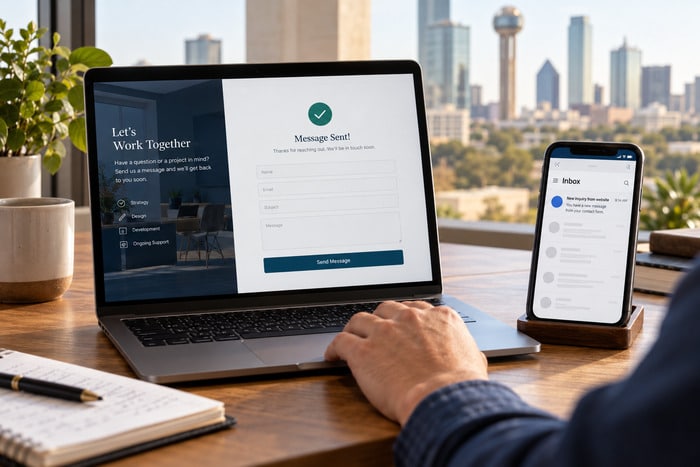
Here’s where a surprising number of websites fail. They provide information. They explain everything. They look professional. And then… nothing. A salesperson eventually asks for the sale. Your website needs to ask too. Call Today. Request an Estimate. Schedule an Appointment. Get a Quote. Book a Consultation. Visit Our Showroom. Order Online.
Whatever action matters to your business should be obvious. Don’t make customers solve a puzzle. If you want phone calls, make the phone number prominent. If you want forms, make the form simple. If you want appointments, make scheduling easy. Your website should always answer: “What should I do next?”
Your Contact Form Isn’t an Application for Security Clearance
Speaking of forms… Keep them reasonable. A customer wants a fence estimate. Do you really need: First name. Middle name. Last name. Address. Secondary address. Phone. Mobile phone. Work phone. Email. Preferred contact method. Preferred contact time. How did you hear about us? Estimated budget. Project timeline. Favorite Beatle. Mother’s maiden name. Blood type.
Every unnecessary field creates friction. Ask for what you genuinely need to begin the conversation. You can learn the rest later.
Job #8: Work on Mobile
Your 24/7 salesperson spends a lot of time inside somebody’s phone. Think about local-business searches. The AC quits. The sink starts leaking. The car won’t start. Someone needs an attorney. Someone wants dinner. Someone needs a dentist. They’re often not sitting at a desktop computer. They’re holding a phone. Your website needs to work there. That means: Readable text. Simple navigation. Clickable phone numbers. Easy forms. Fast loading. Clear buttons. No microscopic menus requiring the fingers of a neurosurgeon. Your website doesn’t merely need to fit on mobile. It needs to sell on mobile.
Job #9: Generate Leads While You Sleep
This is where the salesperson analogy becomes particularly powerful. Imagine arriving Monday morning and finding: Three estimate requests. Two contact forms. An appointment request. Four phone calls generated from the website. Those opportunities didn’t require someone sitting behind a desk waiting for them. The website did its job.
That’s the goal. Google Search → Website → Trust → Call or Lead → Customer Not every visitor becomes a customer. They shouldn’t. But the right visitors should have an obvious path toward becoming one.
Looking Pretty Isn’t Enough
I love attractive websites. Obviously. I’m a website designer. It would be slightly concerning if I said: “Eh. Ugly is fine.” But design isn’t the finish line. A beautiful website that generates nothing is decoration. A successful business website needs to combine: Design + SEO + Content + Trust + Usability + Conversion
That’s what turns a website from a brochure into a business tool. Your site should look good. But it also needs a job.
Stop Measuring Only Website Traffic
Business owners sometimes tell us: “My website had 2,000 visitors!” Great. What happened? How many called? How many filled out a form? How many requested quotes? How many booked appointments? How many became customers? Traffic matters. But traffic is the beginning of the story.
If 10,000 people visit your website and nobody contacts you, something isn’t working. Meanwhile, 500 highly relevant visitors who generate 30 qualified leads might be incredibly valuable. The objective isn’t: Get the most visitors. It’s: Generate business.
Your Website Should Make Your Human Salespeople Better
Here’s another benefit people overlook. A strong website doesn’t replace your sales team. It makes their conversations better. Imagine two prospects.
Prospect A
Knows nothing about you. Hasn’t seen your services. Doesn’t understand your process. Hasn’t read your reviews. Doesn’t know what makes you different. Your salesperson starts at zero.
Prospect B
Visited your website. Read your service page. Looked at projects. Read testimonials. Reviewed your FAQ. Understands your process. Now the conversation begins much further down the road. The website has already done part of the selling. That’s valuable.
What Kind of Salesperson Is Your Website?
Here’s today’s Monday assignment. Visit your website and pretend it’s a salesperson you’ve hired. Then conduct its performance review. Ask: Does it attract potential customers? Does it clearly explain what we do? Does it answer common questions? Does it show why we’re different? Does it establish credibility? Does it show reviews and proof? Does it address customer concerns? Does it work well on mobile? Does it make contacting us easy? Does it clearly ask visitors to take action? Can we track the leads it generates? And the biggest question: If this salesperson worked for me, would I keep paying them? Ouch. But that’s the question.
Your Website Isn’t an Expense If It’s Producing Business
Small-business owners understandably watch expenses. Hosting costs money. Design costs money. SEO costs money. Content costs money. Maintenance costs money. But there’s an important distinction between an expense and an investment. If you spend money on a website that simply sits online… it feels like an expense.
If that website consistently generates: Calls. Leads. Appointments. Estimates. Sales. Customers. Now you’re looking at a business asset. That’s why we tell clients: Don’t build a website just because businesses are supposed to have websites. Build something designed to work.
Put Your Website to Work
At DFW Website Designers, we’ve spent 17+ years helping businesses build websites designed to do more than look pretty. We’ve built 1,250+ websites, and our approach is simple. Your website should help your business: BE FOUND. BUILD TRUST. GET MORE LEADS. GROW. Because your website isn’t a brochure. It’s a salesperson.
And while you’re sleeping tonight… it should still be working. Hopefully without asking for overtime.