You need something online for a new business, service, campaign, event, or offer. Should you build one focused landing page or invest in a complete website? The answer is not automatically “whichever costs less.” A landing page and a full website perform different jobs. The right choice depends on how people will find you, what they need to know, and what action you want them to take.
A landing page can be exactly right for one clear offer. It can also feel incomplete when a customer wants to research the company behind that offer.
A full website can build trust and support long-term growth. It can also be unnecessary when a short campaign needs only one message and one response. Here is how to decide.
What Is a Landing Page?
A landing page is a focused web page designed for a specific audience, offer, or campaign. Someone may reach it from: A Google or social media advertisement, An email campaign, A QR code, A direct-mail piece, A presentation or sales proposal, A social media profile, & A short, memorable URL.
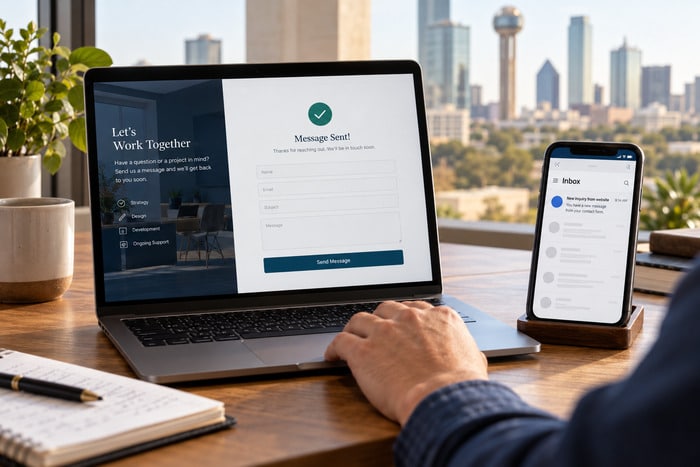
Mailchimp describes a landing page as a standalone page that a person reaches after clicking from an email, advertisement, or other digital location. It typically supports one focused action: What is a landing page?
That action might be:
- Call the business
- Request a quote
- Book an appointment
- Register for an event
- Download a guide
- Join an email list
- Purchase one product
- Apply for a service
A landing page reduces choices so the visitor can concentrate on the next step.
What Is a Full Business Website?
A full website is a connected group of pages that explains a business more broadly. It might include: Homepage, About page, Individual service pages, Products or portfolio, Locations or service areas, Frequently asked questions, Testimonials or case studies, Blog or resource center, Contact page & Privacy and policy pages.
The homepage introduces the organization. Other pages answer deeper questions for people with different needs and levels of awareness. A complete site supports exploration. A landing page supports concentration.
The Fastest Way to Decide
Ask one question: Do visitors need to complete one action, or understand an entire business?
Choose a landing page when: You have one specific offer. You are targeting one audience. Traffic comes from one campaign. You want one primary action. The visitor needs a short explanation. You need to launch quickly.
Choose a full website when: You offer several services or products. Customers compare multiple options. Trust requires more company information. Organic search is an important long-term goal. You serve several locations or industries. You need room for resources, policies, or support. The site must grow with the business.
When a Landing Page Is the Better Choice
You Are Testing a New Offer
Suppose an established company introduces a new service. A focused page can explain the service, answer the most important questions, and measure demand without rebuilding the main website.
You Are Running a Paid Advertising Campaign
An advertisement promises something specific. The destination page should continue that same promise.
If an ad promotes emergency water-heater repair, sending visitors to a general homepage forces them to search for the relevant service. A dedicated landing page can immediately confirm: The service offered, The area served, Why the company is credible & What the visitor should do next.
You Need a Page for an Event or Short-Term Campaign
An event registration, seasonal promotion, candidate page, fundraising drive, or product launch may not need a permanent multi-page site.
You Have One Product, One Service, or One Audience
A consultant with one signature package or a startup validating one product may be able to explain the entire offer clearly on one page.
You Need a Useful Online Presence Quickly
A strong landing page can provide a professional place for prospects to learn and act while a larger website is being planned.
“Quick” should not mean careless. The page still needs clear writing, mobile design, trustworthy contact information, secure hosting, analytics, and a tested lead path.
When a Full Website Is the Better Choice
You Offer Multiple Services
A visitor researching commercial insurance has different questions from someone seeking employee benefits. Separate pages allow each audience to receive a clear explanation without forcing everything into one long page.
Customers Need to Verify the Business
Before calling, prospects may look for: Company history, Team members, Licensing or credentials, Reviews, Project examples, Service areas, Frequently asked questions & Policies and guarantees.
A full website creates room for that evidence.
Search Visibility Is a Long-Term Priority
A one-page site has limited space to answer many distinct search questions. A multi-page website can assign a focused page to each important service, audience, or location.
That does not mean adding thin pages merely to increase the count. Each page should serve a real visitor need and provide useful information.
The Business Will Continue to Grow
A full site provides a structure for adding services, staff, locations, case studies, articles, downloads, and customer resources over time.
Different Visitors Need Different Paths
A new customer, existing customer, job applicant, vendor, and media contact may all arrive with different goals. A complete navigation system helps each person find the right next step.
A Landing Page Is Not the Same as a One-Page Website
The terms are often used interchangeably, but they can describe different things.
Campaign Landing Page
A campaign landing page usually sits beside an existing website and serves one marketing objective. It may not appear in the main navigation.
One-Page Business Website
A one-page website may be the company’s entire web presence. It tries to cover the business introduction, services, trust signals, and contact information in one scrolling page.
Both formats can work. The important question is whether the content and visitor journey match the business goal.
What Every Effective Landing Page Needs
A focused page does not have to be bare. It should include enough information to support the decision.
Clear Headline
The visitor should immediately understand what is being offered and who it is for.
Specific Value
Explain the problem solved or result delivered. Avoid vague claims such as “quality solutions for all your needs.”
Relevant Proof
Depending on the offer, proof may include: Customer reviews, Project photographs, Results or case studies, Years in business, Certifications, Guarantees & Client logos, with permission.
One Primary Call to Action
The page can repeat the same action in several places, but it should not ask visitors to choose among six unrelated goals.
Mobile-Friendly Contact Path
Test the form, phone link, appointment calendar, payment button, or registration process on a real phone.
Measurement
Track the completed action, not merely page views or button clicks. The business should be able to connect traffic sources with useful leads or sales.
What Every Full Website Needs
A full site should not become a collection of filler pages. Each page needs a purpose.
At minimum, many service businesses benefit from:
- A homepage that explains the company quickly
- Dedicated pages for core services
- An About page that builds trust
- Clear geographic information
- Useful proof such as reviews or work examples
- A contact page with tested communication options
- Mobile navigation that is easy to use
- Foundational search information and analytics
- A plan for updates, security, and backups
The exact page count matters less than whether the site answers the questions customers actually ask.
Five Mistakes to Avoid
1. Sending Every Advertisement to the Homepage
The homepage serves many visitors. It may not continue the specific promise made in an advertisement.
2. Turning a Landing Page Into a Miniature Encyclopedia
If every service, team member, company milestone, and blog post is squeezed onto one page, the focused experience disappears.
3. Building a Full Website With No Content Plan
Five empty pages are not automatically better than one useful page. Decide what each page must accomplish before designing it.
4. Removing Too Much Trust Information
A landing page still represents a real business. Visitors may need a company name, contact information, privacy details, service area, and credible proof before responding.
5. Launching Without Testing the Action
The best-looking page fails if its form, phone number, calendar, checkout, or confirmation process does not work.
Can You Start With a Landing Page and Grow Later?
Yes. For many small businesses, that is a practical path. A well-planned landing page can establish: Domain name, Visual direction, Core offer, Primary message, Contact process, Analytics & Early customer feedback. Later, the business can add individual service pages, an About page, resources, locations, and stronger navigation.
The important part is planning the first page so it does not become a technical dead end. Ask whether the platform, hosting, domain, and content can support future expansion.
A Simple Decision Checklist
Choose a Landing Page If:
- The offer can be explained clearly on one page
- One audience is being targeted
- One action defines success
- Traffic comes mainly from ads, email, social media, or QR codes
- The campaign is temporary or being tested
- The business already has a separate main website, or needs a focused first step
Choose a Full Website If:
- The business has several important services or products
- Customers need to research the company before contacting it
- Search visibility across several topics matters
- Multiple audiences need different information
- Locations, staff, resources, or projects need dedicated pages
- The website must support long-term expansion
Build the Smallest Website That Fully Does the Job
The smartest option is not always the smallest page or the largest website. It is the smallest structure that completely supports the customer journey and the business goal. Use a landing page when one audience needs one focused answer and one clear action. Use a full website when customers need to explore, compare, verify, and return for different reasons.
And when the answer is somewhere between those choices, start with a focused foundation that can grow. DFW Website Designers builds campaign landing pages and complete WordPress websites for businesses throughout Dallas–Fort Worth. Our team can help you decide what your audience needs now, what the business will need next, and how to avoid paying for pages that do not serve a purpose.