Let’s play a game. I’m going to give you a paragraph from a fictional plumbing website. See if you can spot the keyword they’re trying to rank for. Ready?
Looking for a plumber Bedford TX? Our plumber Bedford TX company provides professional plumber Bedford TX services for customers searching for a plumber Bedford TX. If you need a reliable plumber Bedford TX, contact our plumber Bedford TX team today for the best plumber Bedford TX services.
Hmm. This is going to be a tough one. Could it possibly be:
PLUMBER BEDFORD TX?
Congratulations. You are now an SEO expert from 2009.
At DFW Website Designers, we’ve spent 17+ years building more than 1,250 websites, and we’ve watched search engine optimization change dramatically. There was a time when businesses—and plenty of SEO companies—approached website content almost mathematically. Want to rank for: plumber Bedford TX Then apparently the solution was: Say “plumber Bedford TX” until both Google and the customer beg you to stop.
Thankfully, we’ve moved on. Or at least… we’re supposed to have moved on. Because I still encounter website copy that sounds like it was written by a robot trying desperately to convince another robot that it understands plumbing. Today, let’s fix that.
Your Customer Is a Human. Write Like It.
This should be the simplest SEO advice you’ll ever hear. The person reading your website is a person. They have a problem. They have questions. They may be worried. They may be comparing companies. They may know absolutely nothing about your industry.
They aren’t impressed because you managed to squeeze the same keyword into a paragraph nine times. They want to know: Can you help me? That’s where good SEO content begins.
SEO Content Has Two Audiences
Technically, your website does need to communicate with search engines. Google needs to understand: What the page is about. What service you provide. Where appropriate, where you provide it. How the page relates to the rest of the website. But here’s the important part: You don’t have to choose between Google and the customer.
Good content can work for both. Yesterday we talked about:
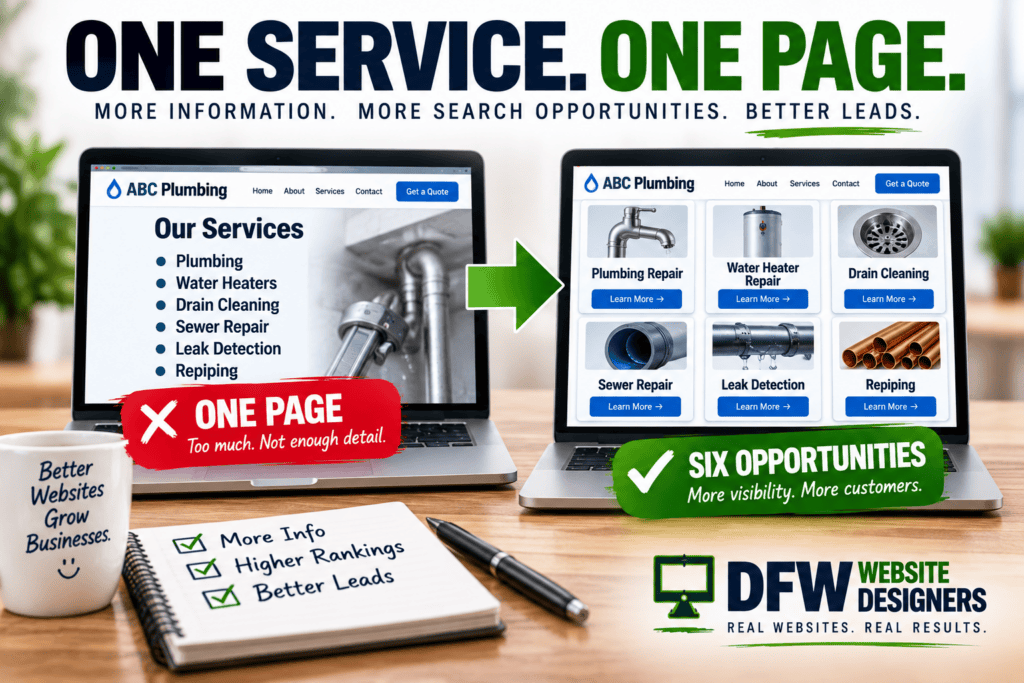
ONE SERVICE. ONE PAGE.
If you have a page dedicated to: Water Heater Repair it isn’t difficult to make the topic clear. The page title can mention water heater repair. The main heading can mention water heater repair. The introduction can explain your water heater repair service. The page can answer questions about water heaters. The photos can show water heaters. The FAQs can discuss water heaters. The call to action can say: REQUEST WATER HEATER SERVICE
We don’t need to scream: WATER HEATER REPAIR every third sentence. Google gets it. The customer gets it. Everybody is happy.
Google Has Been Saying “People First”
Google’s current guidance explicitly encourages creators to produce helpful, reliable, people-first content rather than content made primarily to manipulate search rankings. Google Search Central: Creating Helpful Content
That’s an important distinction. It doesn’t mean: Ignore SEO. It means: Don’t make SEO the reason the content exists. Ask yourself:
If Google disappeared tomorrow, would this page still be useful to one of my customers?
That’s a pretty good test. If the answer is: Yes, we’d send this page to customers all the time. Great. If the answer is: Absolutely not. This page exists solely because somebody told us we needed 1,500 words containing a keyword 23 times. We may need to rethink it.
Keyword Stuffing Isn’t an SEO Strategy
Google’s spam policies specifically identify keyword stuffing as filling a webpage with keywords or numbers in an attempt to manipulate search rankings. Google Search Spam Policies But even if Google didn’t care… your customers would. Read this aloud:
Our Bedford plumbing company offers Bedford plumbing services for Bedford homeowners who need a Bedford plumber for plumbing services in Bedford.
Nobody talks like that. Imagine answering your business phone:
“Thank you for calling DFW Website Designers, your DFW website designer for DFW website design in DFW. If you’re searching for a DFW website designer…”
Click. If it sounds ridiculous when spoken aloud, it probably sounds ridiculous on the website too.
Keywords Aren’t Bad
Let’s make sure we don’t swing too far in the opposite direction. Keywords aren’t evil. They’re useful. Search terms tell us something incredibly valuable:
WHAT PEOPLE ARE LOOKING FOR.
If people search: water heater repair Bedford TX that’s useful information. It tells us: They have a water heater problem. They’re probably looking for repair. Location matters. They may have commercial intent. Wonderful.
Use that knowledge to create the best page possible for someone with that need. The keyword should help us understand the customer. It shouldn’t turn the customer into a keyword.
Think in Topics, Problems and Questions
Instead of asking: How many times should I use the keyword? ask: What would someone considering this service need to know? Let’s use:
WATER HEATER REPAIR
What might the customer ask? Why isn’t my water getting hot? Can my water heater be repaired? Should I repair or replace it? How long do water heaters last? Do you work on tankless systems? Do you offer same-day service? What brands do you service? How long does replacement take? Do you haul away the old unit? Do you serve my neighborhood?
Answer those. Now we have useful content. And notice something interesting. Without trying very hard, we’re naturally going to use words related to: Water heaters. Repairs. Replacement. Tankless systems. Hot water. Service. Installation. Those terms belong there because we’re actually discussing the topic. That’s a much healthier approach.
Write Like Your Best Salesperson Talks
Here’s one of my favorite content-writing exercises. Ask your best salesperson:
“How would you explain this service to a customer sitting across from you?”
Then listen. They probably won’t say:
“Our innovative, industry-leading organization leverages customer-centric solutions.”
They’ll say: “Tell me what’s happening.”
Then they’ll ask questions. They’ll explain the problem. They’ll describe options. They’ll address concerns. They’ll tell the customer what happens next. That’s the voice your website needs. Knowledgeable. Helpful. Confident. Human.
Answer Real Questions
Today’s graphic has three simple rules. The first:
ANSWER REAL QUESTIONS.
Where do you find those questions? You don’t need an expensive SEO tool to begin. Ask: Your receptionist. Your salespeople. Your technicians. Your estimator. Your customer-service team. Your owner. What do customers ask every day? Write them down. If your staff has answered a question 100 times… your website should probably answer it too.
Your Inbox Is a Content Strategy
Look at customer emails. What do they ask? How much does this cost? Do you serve Arlington? Can you work on my brand? How quickly can you come out? Do you offer financing? Is this covered by insurance? What’s included? Do I need to prepare anything? Every one of those questions could improve: A service page. An FAQ. A blog post. A landing page. A social-media post. Maybe even a video. Your customers are constantly telling you what content to create. Listen to them.
Explain Real Problems
Second rule:
EXPLAIN REAL PROBLEMS.
Customers often don’t know the technical name for what they need. They know the symptom. A homeowner may not search: thermocouple failure They may ask: Why does my water heater pilot light keep going out? They may not know they need: sewer lateral repair They know: My drains keep backing up. They may not know they need: responsive website redesign
They know: My website looks terrible on my phone. That’s important. Write about the problem from the customer’s perspective. Then explain the solution.
Don’t Show Off Your Vocabulary
Industry expertise is valuable. Industry jargon isn’t always. You know what your acronyms mean. Your customer may not. If technical terminology is important, use it. Then explain it. Don’t make the customer feel like they need a certification just to understand your Services page.
The goal isn’t to demonstrate: LOOK HOW MUCH WE KNOW. The goal is: WE KNOW ENOUGH TO HELP YOU. Subtle difference. Huge impact.
Help People Take the Next Step
Third rule:
HELP PEOPLE TAKE THE NEXT STEP.
Useful content shouldn’t end with: Well, good luck! You’ve answered the question. You’ve explained the problem. Now what? Maybe: Call us. Request an estimate. Schedule service. Book a consultation. View the related service. Download the guide. See examples. Contact our team. The next step should match the page. Remember yesterday? Water heater page: REQUEST WATER HEATER SERVICE Much better than: SUBMIT.
Every Page Should Have a Purpose
Before writing any website page, finish this sentence:
After reading this page, I want the visitor to __________.
Call? Request a quote? Understand a service? Choose between two options? Schedule? Visit another page? If you don’t know what you want them to do… they probably won’t know either.
Stop Writing 1,500 Words Just Because Somebody Said So
Here’s another old SEO habit. Someone says:
“Google likes 1,500-word pages.”
So we take a topic that needs 500 useful words… and stretch it to 1,500. Now the reader gets: A history of plumbing. The invention of copper pipe. A philosophical discussion of water. Seven paragraphs explaining what a plumber is.
There isn’t a magic word count that makes content good. Some topics need depth. Some don’t. Write enough to satisfy the customer’s need. Don’t write extra paragraphs because you’re trying to hit an imaginary SEO odometer.
Longer Isn’t Better. Better Is Better.
A 2,000-word article can be fantastic. A 500-word service page can be fantastic. A 100-word answer can be exactly what somebody needs. The question is: Did we answer the question well?
Google’s people-first guidance asks whether content provides substantial, complete or comprehensive information appropriate to the topic—not whether it hits an arbitrary universal word count. Google Search Central: Creating Helpful Content Write what the subject deserves. Then stop. Your customer will thank you.
Local Content Should Actually Be Local
Now let’s talk about local SEO. Yesterday we touched on city pages. If you’re targeting: Plumber Bedford TX it’s perfectly reasonable to explain that you provide plumbing service in Bedford. What’s not useful is writing:
“Bedford is a vibrant city with wonderful residents and businesses. If you live in Bedford, our Bedford plumbers proudly provide Bedford plumbing services throughout beautiful Bedford…”
Nobody needed that. Local content should help the local customer. Maybe discuss: Actual service coverage. Response expectations. Local office/location details. Types of properties commonly served. Neighborhoods or relevant areas. Local regulations when genuinely applicable. Real projects. Customer testimonials from the area. Useful geographic information. Make the page local because the business relationship is local, not because you inserted the city name 42 times.
City Pages Need a Reason to Exist
Google’s spam policies also address doorway abuse—pages created primarily to rank for similar searches and funnel users toward essentially the same destination. Google Search Spam Policies
That’s why our philosophy with city pages should be: MAKE THEM USEFUL. Don’t create: Bedford page. Euless page. Hurst page. Grapevine page. Colleyville page. where the only difference is the city name. Give each page a reason to exist. Otherwise, we’re not building useful local content. We’re playing Mad Libs with Texas cities.
Use Your Actual Experience
Here’s something many small businesses have that giant national websites don’t.
REAL EXPERIENCE.
You’ve actually done the work. Use it. Instead of generic content:
“Water heaters can experience many common problems.”
Try:
“One of the most common calls our technicians receive is a homeowner who still has some hot water, but it runs out much faster than it used to.”
Now we’re talking like someone who actually does this. Discuss: Problems you’ve encountered. Mistakes customers commonly make. Questions you regularly answer. What you’ve learned. How your process works. What surprises customers. What you recommend and why. That’s content competitors can’t duplicate simply by asking AI to: “Write 1,000 words about water heater repair.”
AI Makes Generic Content Easier Than Ever
Which brings us to 2026. Creating generic content has never been easier. Anyone can generate: 10 Reasons to Maintain Your Roof, 5 Benefits of Professional Plumbing, Why You Need a Great Website, in seconds. That’s not necessarily bad.
AI can be an excellent writing and research assistant. Obviously… I’m a little biased. But the easier generic information becomes to create, the more important your unique business knowledge becomes. Your content should contain things that come from: Your experience. Your customers. Your projects. Your process. Your opinions based on professional experience. Your local market. Your results. Your expertise. That’s where the value is.
AI Search Still Needs Useful Information
Search itself is changing too. People increasingly encounter AI-generated summaries and AI-assisted search experiences alongside traditional results.
Google’s current guidance for AI search features says that the same foundational SEO best practices remain relevant and that there are no special additional technical requirements or special AI files required simply to appear in these experiences. Google Search Central: AI Features and Your Website
That’s an important point. You don’t need: SECRET AI SEO TRICK #47. You still need: Useful content. Accessible pages. Clear structure. Good technical SEO. Relevant information. A good user experience. In other words: Help people.
Search Is Becoming More Conversational
This is another reason customer questions matter. Traditional search: water heater repair Bedford TX Conversational search: Why is my water heater only staying hot for ten minutes and should I repair it or replace it? See the difference?
The second query sounds like a person talking. If your website contains thoughtful answers to real customer questions, you’re creating information that fits naturally into a more conversational search environment. Again: Don’t write for robots. Write for the person asking the question.
Don’t Chase Every Search Phrase
Another old SEO tactic: Create a separate page for every tiny keyword variation. Web Designer DFW, Website Designer DFW, DFW Web Designer, DFW Website Designer, Website Design DFW. Do we need five nearly identical pages? Probably not. Build one excellent page that comprehensively addresses the topic.
Google’s SEO Starter Guide encourages logical organization and useful content rather than creating unnecessary duplication. Google SEO Starter Guide Think in: Topics. Services. Problems. Questions. Customer intent. Not endless keyword permutations.
Your Headline Should Sound Human Too
Bad:
PROFESSIONAL BEDFORD TX PLUMBER SERVICES
Better:
Need a Plumber in Bedford?
Then: Leaky faucet? Clogged drain? No hot water? Tell us what’s going on and we’ll help you figure out the next step. That’s today’s graphic. The phrase: plumber in Bedford still appears. We’re not afraid of the keyword. We’re just using it naturally. Then the content immediately addresses the customer’s problem. That’s good marketing. And good SEO.
Titles and Headings Still Matter
Writing naturally doesn’t mean abandoning structure. Give pages descriptive titles. Use a clear main heading. Organize sections with useful subheadings. Use descriptive URLs. Connect related pages with internal links.
Google’s SEO Starter Guide continues to recommend descriptive, useful organization that helps users and search engines understand website content. Google SEO Starter Guide
The technical fundamentals still matter. We’re simply not sacrificing readability to achieve them.
FAQs Are Fantastic—When They’re Real
I love FAQs. But not fake FAQs written because somebody wanted another place to insert a keyword. Bad FAQ:
Who is the best plumber Bedford TX?
Our company is the best plumber Bedford TX for anyone searching for plumber Bedford TX services.
Please make it stop. Good FAQ:
Do you charge a service-call fee?
Do you offer emergency plumbing service?
Can you repair tankless water heaters?
How quickly can you usually schedule an appointment?
Do you provide estimates before starting work?
Those are actual customer questions. Answer them honestly.
Pricing Is a Question Too
Here’s the question businesses love avoiding. HOW MUCH DOES IT COST? Sometimes you can’t provide an exact price. Fine. But perhaps you can explain: What affects price. Typical ranges when appropriate. How estimates work. What’s included. Why prices vary. Whether financing exists. Whether there’s a service fee.
You don’t necessarily need to publish a price list. But don’t pretend customers aren’t wondering. Useful content addresses the uncomfortable questions too.
Write Content Your Sales Team Wants Customers to Read
Here’s another excellent test. Ask your salesperson:
“What do you wish every customer understood before calling?”
That’s your content plan. Maybe: Why cheap quotes aren’t comparable. Why a particular repair isn’t always possible. Why project timelines vary. Why preparation matters. Why permits are required. Why one product costs more. Why DIY creates problems. Write those articles. Then your salesperson can send them to prospects. Now the content is doing double duty: SEO + SALES. That’s when content becomes a business asset.
Good Content Builds Trust Before the Call
Imagine two companies. Company A says:
WE’RE THE BEST! CALL NOW!
Company B explains: The problem. Options. Costs. Process. Common mistakes. What to expect. When professional help is needed. Who may not need the service. Which company feels more credible? Usually the one willing to teach. Helpful content demonstrates expertise without having to repeatedly announce: WE ARE EXPERTS. Show it.
Sometimes the Best Answer Is “You Don’t Need Us”
This is powerful. Suppose a customer’s problem can easily be fixed without hiring you. Tell them.
“Before scheduling a service call, check this.”
Did you just lose a lead? Maybe. But perhaps you gained trust. And when they have a problem they can’t solve? Guess who they remember? Helpful businesses win long-term.
Your Content Should Sound Like Your Business
This matters too. A law firm may sound different from a taco restaurant. A roofing company may sound different from a financial advisor. A children’s organization may sound different from an industrial manufacturer. Don’t force every business into the same generic corporate voice. Your website should feel like: YOU. Professional doesn’t have to mean personality-free.
I mean… you’ve made it this far through an SEO article containing jokes about robots, plumbers and Mad Libs. You can teach and still sound human.
The Read-It-Out-Loud Test
Here’s today’s easiest assignment. Open one of your important service pages. Read it aloud. Seriously. If you get to a sentence and think: “I would never say this to a customer.” Highlight it. If you stumble because the sentence contains seven keywords… highlight it.
If you don’t understand what it means… definitely highlight it. Then rewrite the paragraph like you’re explaining the same idea to a customer sitting across the desk. That’s usually better.
The Wednesday Human Content Test
Take one page and ask:
1. Is it obvious what this page is about?
YES / NO
2. Does it answer questions customers actually ask?
YES / NO
3. Does it explain real customer problems?
YES / NO
4. Does it demonstrate actual experience?
YES / NO
5. Does it sound natural when read aloud?
YES / NO
6. Is the location mentioned naturally where relevant?
YES / NO
7. Is there a clear next step?
YES / NO
8. Would I send this page to a real prospect?
YES / NO
That last question may be the most important. If you wouldn’t send the page to a customer… why are we asking Google to send customers to it?
Good SEO Content Helps the Customer First
That’s the message on today’s square. Not: IGNORE GOOGLE. Not: KEYWORDS DON’T MATTER. Not: SEO IS DEAD. It’s much simpler:
HELP THE CUSTOMER FIRST.
Answer real questions. Explain real problems. Demonstrate real expertise. Make information easy to understand. Help them take the next step. Then make sure the page is structured so search engines can understand it too. That’s SEO content I can get behind.
Help People. Get Found. Win Business.
At DFW Website Designers, we’ve spent 17+ years helping businesses throughout Dallas–Fort Worth build websites designed for both: PEOPLE and: SEARCH. We’ve built more than 1,250 websites, and today our work includes: Website Design, SEO, Service Pages, SEO City Pages, Blogging, and Content Strategy. But regardless of which service we’re providing, the principle stays the same.
Behind every search is a person. A person with: A problem. A question. A need. A decision to make. Write for that person. Help that person. Give them a useful answer. Make their next step easy. Because your customer isn’t: KEYWORD VOLUME: 390/MONTH
Your customer is: Mike. His water heater is broken. He hasn’t showered. He’s annoyed. And he wants to know whether you can fix it. So tell Mike. Clearly. Naturally. Helpfully. And the next time someone tells you that good SEO requires saying: “plumber Bedford TX” 37 times… you have my permission to respond: