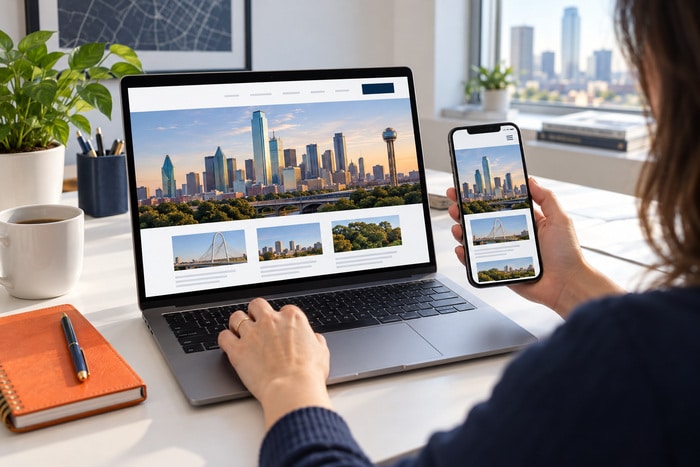
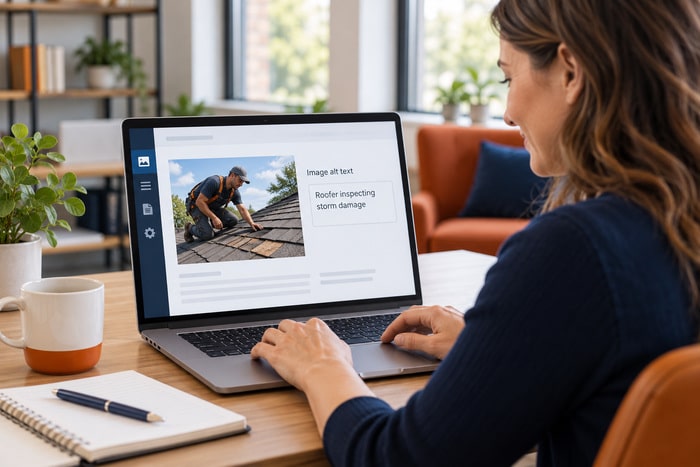
A roofing company serves Dallas, Fort Worth, Arlington, Bedford, Grapevine, and several surrounding cities. The website has a page for every location. At first glance, that sounds like a strong local SEO plan. Then you open the pages.
Each one uses the same headline, same paragraphs, same stock photo, same frequently asked questions, and same call to action. The only meaningful difference is the city name. That is not a local content strategy. It is a mail merge. City pages can be valuable when they help a visitor understand how a business serves a specific community. They become weak when their primary purpose is to repeat a keyword and send everyone to the same generic sales page.
The better question is not, “How many cities can we list?” It is, “What can we say on each page that is genuinely useful to someone in that city?”
What Is a Local SEO City Page?
A local SEO city page—also called a service-area page or local landing page—is a page built around a real combination of service and geography.
Examples include:
- Residential plumbing in Bedford
- Commercial roofing in Fort Worth
- Family law services in Arlington
- Senior moving services in Grapevine
- Office cleaning in Irving
The page should help a local visitor decide whether the company serves their area, understands their needs, and offers the right service. A good city page is not pretending that the business has an office where it does not. It accurately explains the relationship between the company and the area.
Why Copy-and-Paste City Pages Are a Problem
Search engines are only part of the issue. Visitors notice repetition too. Imagine landing on a page titled “Air Conditioning Repair in Plano.” The introduction says the company proudly serves Plano. Everything after that could apply to any HVAC company in any city. There is no mention of response area, common property types, local projects, neighborhood coverage, or what happens after someone calls.
The visitor has learned almost nothing local. Google’s current spam policies describe doorway abuse as pages created for similar searches that funnel users toward another destination. One example is substantially similar pages aimed at regions or cities. That does not mean every service-area page is prohibited. It means the pages should provide useful, distinct value instead of existing mainly to capture variations of a search phrase.
Google’s SEO guidance also emphasizes unique, helpful, reliable, people-first content. In plain language: build the page for the person who needs the service, not merely for a list of city keywords.
What Makes a City Page Genuinely Local?
The city name is only the beginning. A useful page combines local context with specific service information and believable proof.
1. An Accurate Service-Area Statement
Explain how the company actually serves the city.
For example:
Our Bedford-based team provides scheduled website consultations and remote support to small businesses throughout Arlington and the wider DFW area. That is clearer than implying there is a storefront in Arlington.
Include practical details when relevant:
- Whether service is available citywide
- Whether travel or delivery fees apply
- Typical scheduling boundaries
- Emergency or after-hours availability
- Residential, commercial, or municipal coverage
Avoid claiming a local office, address, or phone presence that does not exist.
2. Services That Match the Local Audience
Do not simply paste the company’s complete service list onto every page. Lead with the services most relevant to that city or audience. A contractor might emphasize historic-home renovations in one area and commercial tenant improvements in another. A moving company might discuss apartment moves near a university on one page and corporate relocation on another.
Useful questions include: Which services do customers in this city request most often? Are there property types or industries that are especially common? Does the city have scheduling, access, permitting, or climate factors worth explaining? Which service should be the primary call to action? Local specificity should come from real experience, not stereotypes or invented facts.
3. Real Local Proof
Proof makes a city page credible. Use material the business can verify.
Possible proof elements include: A completed project in or near the city, A customer testimonial connected to the service area, Original project photographs, A short case study, Years serving the broader region, Relevant licenses, certifications, or associations & A map showing the legitimate service area.
Respect customer privacy. Do not publish a residential address or identifying details without permission. A description such as “kitchen remodel in north Arlington” may provide enough context.
4. Locally Relevant Questions and Answers
Frequently asked questions should answer what people in that service area genuinely ask. Examples: Do you charge a trip fee to serve this city? How quickly can you schedule an estimate? Do you work with the city’s permit process? Do you serve apartments, HOAs, or commercial properties? Which nearby communities are also covered? Can the work be completed remotely?
Do not force the city name into every question and answer. Natural language is easier to read and more trustworthy.
5. A Clear Next Step
The page should make it easy to act without sending the visitor through several unrelated pages. Choose a call to action that matches the service: Request an estimate, Schedule a consultation, Check availability, Call for emergency service, Upload project details, & Ask whether your address is in the service area.
Tell visitors what happens after they act. If the form requests a quote rather than confirming a booking, say so.
What Can Be Shared Across City Pages?
Every sentence does not need to be unique. Some company information naturally remains consistent: Business history, Core process, Warranty or guarantee language, Licensing and insurance details, Financing information, & Company-wide policies. The problem is not having consistent facts. The problem is when those shared facts make up nearly the entire page.
A practical structure is to use a common branded framework while giving each location page a distinct local core:
- City-specific introduction
- Relevant services
- Local project or proof
- Area-specific considerations
- Useful local FAQs
- Clear contact path
This keeps the website consistent without making every page interchangeable.
Warning Signs Your City Pages Need Work
Open several location pages side by side and look for these problems:
- Only the city name changes.
- Every page has the same title and meta description pattern.
- The same stock photo appears on every page.
- There are no local projects, testimonials, or examples.
- The copy makes unsupported claims about local expertise.
- The page lists an office address that is not staffed.
- Every city page redirects visitors to the same generic page.
- The content is awkward because the location name is repeated excessively.
- Visitors cannot tell whether the company truly serves their address.
- The pages are missing from the website’s normal navigation or service-area structure.
One warning sign does not automatically make a page useless. A pattern of them means the page probably needs a more thoughtful purpose.
A Simple City-Page Content Worksheet
Before writing a new page, gather real inputs from the business.
Local Service Facts
- City or service area:
- Primary service offered:
- Secondary services:
- Travel, delivery, or scheduling limitations:
- Nearby areas also served:
Local Experience
- Completed project or customer story:
- Original photo available:
- Common customer question:
- Relevant property type or industry:
- Team member with first-hand experience:
Conversion Details
- Primary call to action:
- Phone or form destination:
- Expected response time:
- Information the customer should prepare:
- What happens after submission:
If most of the worksheet is blank, the business may not yet have enough material for a strong standalone page. It may be better to create one useful regional service-area page, gather real experience, and expand deliberately.
Should Every City Get Its Own Page?
Not necessarily.
A separate page makes sense when the business actually serves the area and can provide enough distinct information to help someone there. A broader regional page may be better when multiple small communities have the same service details and little unique material.
Do not create pages simply because a keyword tool produced a list of nearby cities. Ask: Is there real customer demand in this area? Can we describe the service accurately? Do we have local proof or experience? Will this page answer questions the main service page does not? Can a visitor take a useful next step from the page? If the answer is no, adding another URL may create maintenance work without creating much customer value.
Keep Published City Pages Current
Local pages are not finished forever. Review them at least periodically and whenever the business changes its services or coverage.
Check for: Outdated phone numbers or forms, Service areas the company no longer covers, Old project photos, Broken map links, Expired offers, Incorrect hours, Changes to licensing or scheduling & Duplicate title tags and meta descriptions. Google’s SEO Starter Guide recommends keeping content current and creating unique page descriptions. Those are useful practices for customers as well as search visibility.
Build Fewer Pages With More Local Value
A hundred thin city pages can look impressive in a spreadsheet. Ten useful pages can do more to earn trust if each one demonstrates real knowledge, relevant services, credible proof, and a clear next step. The goal is not to hide duplication. The goal is to replace duplication with information a local customer would actually want.
DFW Website Designers creates service-area and city-page campaigns for small businesses that want to explain where they work and what they offer. If your current location pages feel copied, vague, or disconnected from real customer experience, call 817-247-6003 to discuss a stronger local content plan.