The right virtual assistant outsourcing partner depends on one question most lists skip: who hires, pays and manages the assistant once the contract starts. This guide sorts 11 providers into four buyer tiers, each with the same short profile.
- Direct hire from Latin America, no monthly markup → Tier 1 placement firms
- Provider handles training, oversight and cover → Tier 2 managed services
- Lowest cost, and you manage everything → Tier 3 offshore options
- One-off projects → Tier 4 marketplaces
Three checks before you sign: who is the assistant’s legal employer, what happens on day one of an unplanned absence, and what every fee adds up to.
Why Most VA Outsourcing Lists Fail Small Business Owners
Most lists rank a $69-a-month job board next to a premium staffing firm. Both are sold as outsourcing, but one gives you access to candidates and the other gives you an employed assistant with a manager and a backup. Pricing is also quoted per hour, per bundle, per month or per placement, so headline numbers rarely compare.
Four Outsourcing Models
Direct-hire placement: a recruiter screens candidates, you pick one, and you usually pay a one-time fee plus the assistant’s rate. You handle training and daily management.
Managed service: a monthly subscription or hour bundle. The provider recruits, trains and supervises, often with backup cover.
Job board: you pay for database access, then recruit, contract and pay the hire yourself.
Freelance marketplace: per-project or hourly work, with a platform fee on each payment.
The Four Outsourcing Tiers at a Glance
|
Tier |
Best for |
Who manages the assistant |
|
1: Latin America placement |
A dedicated hire working US hours |
You, with recruiter support |
|
2: Managed services |
Owners who want training and cover handled |
The provider |
|
3: Offshore subscriptions and job boards |
The lowest monthly cost |
You, mostly |
|
4: Freelance marketplaces |
Defined projects |
You |
How we chose: every provider was checked against its own website in October 2026. Pricing appears only where the provider publishes it, and is left out where its own pages conflict. Numbering runs within tiers and is not a quality ranking.
Tier 1: Latin America Placement and Nearshore Outsourcing
1. Remote Leverage
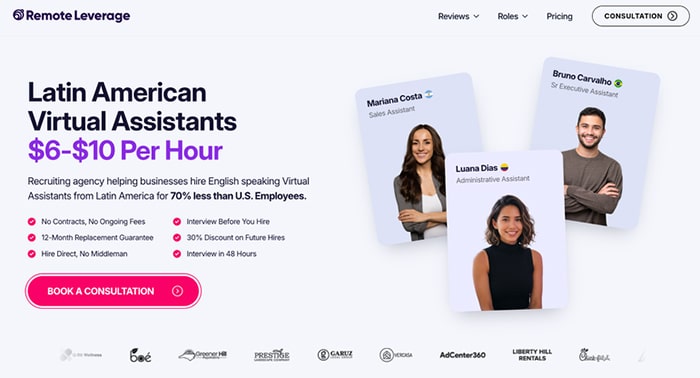
Model: Remote Leverage is a recruiting agency that charges a one-time flat fee only after you hire, and you then hire the assistant directly. Four to six pre-vetted candidates arrive within 48 to 72 hours.
Published pricing: You set the assistant’s pay, which goes to them in full: $6 to $10 an hour for entry level, $11 to $15 for highly experienced. Minimum 20 hours a week, no contracts.
Continuity: 12-month replacement guarantee at no extra cost.
Not a fit if: you need under 20 hours a week, or want the provider to supervise daily work.
2. Virtual Latinos

Model: Agency with an all-inclusive monthly rate covering recruitment, payroll and retention. Assistants speak English plus Spanish or Portuguese.
Published pricing: $1.6K to $4.4K a month depending on experience, with no recruitment or setup fees.
Continuity: Replacement at no extra cost, with conditions.
Not a fit if: you’d rather pay a one-time fee and avoid a monthly provider charge.
3. South
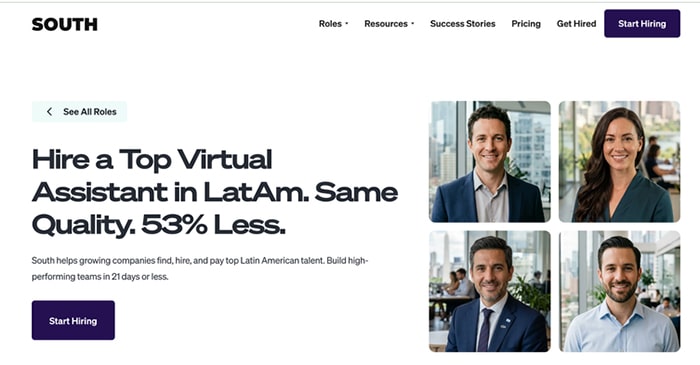
Model: Staffing on one flat monthly rate per hire, or headhunting for a single fee. Full-time roles only.
Published pricing: Rates are confirmed per role. Interviewing is free, and you pay only if you hire.
Continuity: Free replacement on staffing, and a 120-day guarantee on headhunting.
Not a fit if: you only need part-time help.
Tier 2: Managed VA Outsourcing Services
4. BELAY

Model: A Client Success Consultant matches you with one of nearly 2,000 US-based professionals, in about a week on average.
Published pricing: Not published. BELAY’s own guide puts typical US virtual assistant rates at $30 to $75 an hour.
Continuity: The consultant stays involved after onboarding.
Not a fit if: you need evening or weekend coverage.
5. Boldly

Model: Premium subscription staffing. US-based staff are employed by Boldly, and you meet your assistant before paying.
Published pricing: Monthly hour plans on its site, priced separately for New York. Specialist tasks cost extra.
Continuity: A refund of that month’s fees if you’re not satisfied.
Not a fit if: budget is your main filter.
6. Prialto

Model: Managed units of 55 hours a month, delivered by trained assistants in the Philippines, Guatemala and Kenya with a US-based Engagement Manager.
Published pricing: $1,500 a month per unit, with no overage fees.
Continuity: Primary and secondary backup assistants.
Not a fit if: you need well under 55 hours a month.
7. Time etc

Model: Monthly hour bundles with a dedicated US-based assistant.
Published pricing: $390 for 10 hours up to $2,160 for 60. No setup fee, and you can cancel any time.
Continuity: Holiday and sickness cover built in.
Not a fit if: you need a one-off project, or full-time hours at a published price.
Tier 3: Offshore Outsourcing, Subscriptions and Job Boards
8. Wishup

Model: Monthly subscription for a dedicated assistant working four or eight hours each business day, aligned to US hours, with a VA manager.
Published pricing: Figures differ across Wishup’s own pages, so confirm directly. Billing is month-to-month.
Continuity: Free replacement, with a backup assistant on its Elite plan.
Not a fit if: you want a one-time fee instead of ongoing billing.
9. OnlineJobs.ph

Model: Philippines job board. You hire and pay workers yourself, and it takes no cut of salaries.
Published pricing: Pro is $69 a month for 75 contacts. Premium is $99 a month for 500 contacts plus background data checks. Cancel once you’ve hired.
Continuity: None beyond your own hiring.
Not a fit if: you can’t spare time to recruit and manage.
Tier 4: Freelance Marketplaces for Project Outsourcing
10. Upwork
Model: Hourly and fixed-price contracts with freelancers worldwide.
Published pricing: On the Basic plan, clients pay a 3% to 5% service fee per payment, plus a contract initiation fee on each new contract.
Continuity: None built in.
Not a fit if: you want one dedicated daily assistant.
11. Fiverr

Model: Packaged gigs you order directly, with no bidding.
Published pricing: A 5.5% service fee at checkout, plus $3.50 on orders under $200.
Continuity: None built in.
Not a fit if: you need ongoing inbox or calendar coverage.
Choosing the Right Outsourcing Partner
- Count your hours. Track the tasks you’d delegate for two weeks, and note any repeat customer questions a hardworking website could answer instead. Light, steady loads fit hour bundles, while 20 or more hours a week usually justifies a dedicated hire.
- Decide who manages. With documented processes, a direct hire gives the most control for the least ongoing cost. Without them, a managed service earns its premium.
- Confirm who employs the assistant, and get the answer in writing.
- Check exit terms: notice period, handover and access removal.
Compliance Checkpoint
Working remotely doesn’t make someone an independent contractor. For US federal employment tax purposes, the IRS weighs behavioral control, financial control and the relationship of the parties, and Form SS-8 lets you request a determination when status is unclear. For US contractors, collect a Form W-9 and file Form 1099-NEC when required. Workers outside the US may need different documents. This is general information, not legal or tax advice.
Frequently Asked Questions
How much does it cost to outsource to a virtual assistant?
Published examples run from $390 a month for 10 hours of a US assistant to $1,500 for a 55-hour managed unit, and from $1.6K a month for an all-in Latin American assistant. Placement firms charge a one-time fee plus the assistant’s pay.
What’s the difference between onshore, nearshore and offshore VA outsourcing?
Onshore means US-based, which suits client-facing work. Nearshore usually means Latin America, with hours close to US time zones. Offshore, such as the Philippines, usually costs the least but overlaps less with the US working day.
What happens if my virtual assistant quits or gets sick?
Managed services often supply a backup, placement firms usually offer a replacement window, and job boards and marketplaces leave re-hiring to you.