A medical front desk rarely gets a quiet hour. Patients call to book, reschedule, ask about insurance and check on referrals, often while staff are checking someone in.
Every unanswered ring is a patient who may simply call the next practice on their list.
AI answering services pick up those calls around the clock. The catch in healthcare is paperwork, not technology.
HIPAA expects practices to protect electronic patient information under its Security Rule, and any vendor handling that information on their behalf needs a signed Business Associate Agreement (BAA).
Vendors differ sharply in what that agreement covers. So this comparison skips feature checklists and looks at what practices actually decide on: BAA coverage, the billing unit, the starting price and the best fit.
Every price and compliance claim below comes from each vendor’s own pricing page, help center or trust page, checked in October 2026.
Key Takeaways
- A HIPAA label is not a BAA. Ask what the agreement covers. Quo’s BAA, for example, leaves out texting and AI call summaries.
- Billing units decide the real cost. RingCentral bills minutes, Nextiva bills interactions, Quo bills calls and Allo bills seats.
- You may not need a new phone system. RingCentral’s AI Receptionist now runs standalone on any phone system from $49 a month.
- Healthcare-only platforms trade price transparency for depth. Weave builds its AI Receptionist into a full patient communication platform but lists no public price for it.
AI medical answering services at a glance
| Service | HIPAA position (vendor’s own words) | Starting price | Billed by | Best for |
|---|---|---|---|---|
| Central AI | Fully HIPAA compliant, BAA on request | Plans scale with call volume, 10-day free trial | Calls | Small practices that want AI answering plus a free built-in CRM |
| RingCentral AI Receptionist | Designed to support HIPAA compliance | $49/mo standalone or $39/mo RingEX add-on, 100 minutes | Minutes ($0.50 after) | Practices keeping their current phone system |
| Nextiva XBert | BAA on HIPAA plans, some voicemail features switched off | $99/mo for 100 interactions, plus a Nextiva plan | Interactions ($0.99 after) | Practices answering calls, texts and web chat in one place |
| Allo | BAA add-on covering calls, recordings, transcripts and AI summaries | $32/seat plus $32/AI agent per month, billed yearly, plus $50/mo BAA | Seats | Small teams that want the broadest written BAA |
| Quo Sona | BAA on Business and Scale plans, AI use needs patient authorization | 10 calls free, then $25/mo for 40 calls, plus a Quo plan | Calls | Low call volumes on Quo already |
| Weave | AI Receptionist designed to meet HIPAA standards | Not listed publicly | Not published | Practices wanting AI inside a full patient communication platform |
How these services were checked
Each service had to answer phone calls with AI and publish a HIPAA position on its own website.
Tools that only claimed HIPAA readiness through third-party reviews were left out, since a practice can’t hold a vendor to someone else’s summary.
Prices come from vendor pricing pages and help centers in October 2026. Features were taken from product pages, not demos, so treat them as vendor-stated and confirm the ones you rely on during a trial.
The 6 services, reviewed
1. Central AI
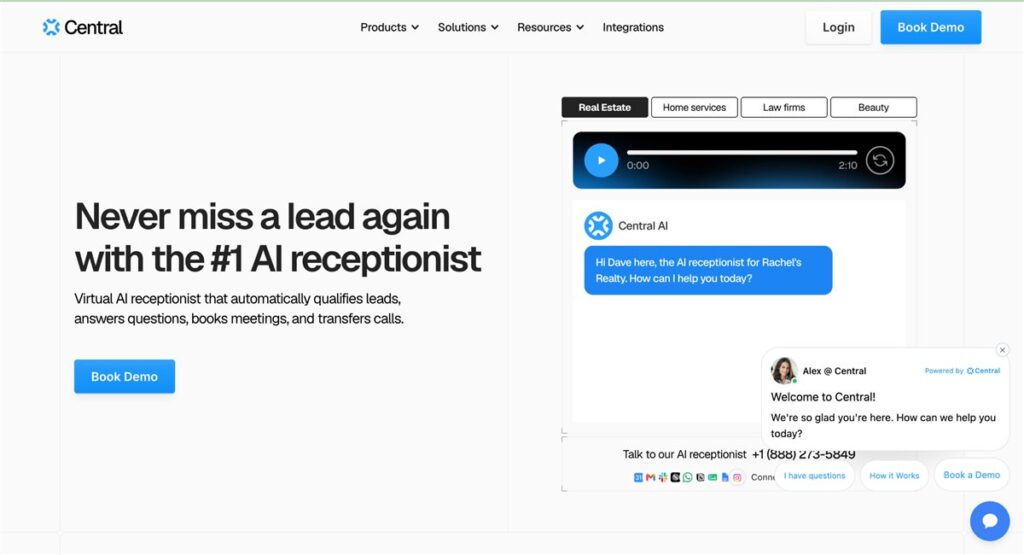
Central AI is an AI receptionist that answers calls 24/7, qualifies callers, answers questions and books appointments during the call.
It trains itself from your website and uploaded documents, so your hours, policies and FAQs are covered without writing scripts.
Why it fits medical practices: The company’s trust page states it is fully HIPAA compliant, offers a BAA on request and holds ISO 27001:2022 certification. It also says customer data processed by its AI is never used for model training.
Worth knowing: Bookings sync with Cal.com, Calendly or Google Calendar, and every call gets a written summary. A free built-in CRM stores caller details, and the receptionist speaks 30+ languages.
Pricing: Plans scale with monthly call volume, and all of them include booking, lead capture, call summaries and 24/7 answering. A 10-day free trial comes first.
2. RingCentral AI Receptionist
RingCentral’s AI Receptionist (AIR) answers calls around the clock, handles FAQs and routes callers by name, location or keyword. It now sells as a standalone plan that works with any phone system, so you don’t need RingCentral’s phone service to use it.
Why it fits medical practices: RingCentral says AIR is designed to support HIPAA compliance, with encryption, access controls and audit logging. It books and reschedules appointments through your calendar and logs caller details to Salesforce, HubSpot or Zoho.
Worth knowing: The pricing page describes HIPAA support but doesn’t spell out BAA terms, so get the agreement in writing. Calls round up in 30-second increments, which adds up on longer calls.
Pricing: $49 a month standalone or $39 as a RingEX add-on, each with 100 minutes, then $0.50 a minute. Both plans come with a 14-day free trial.
3. Nextiva XBert
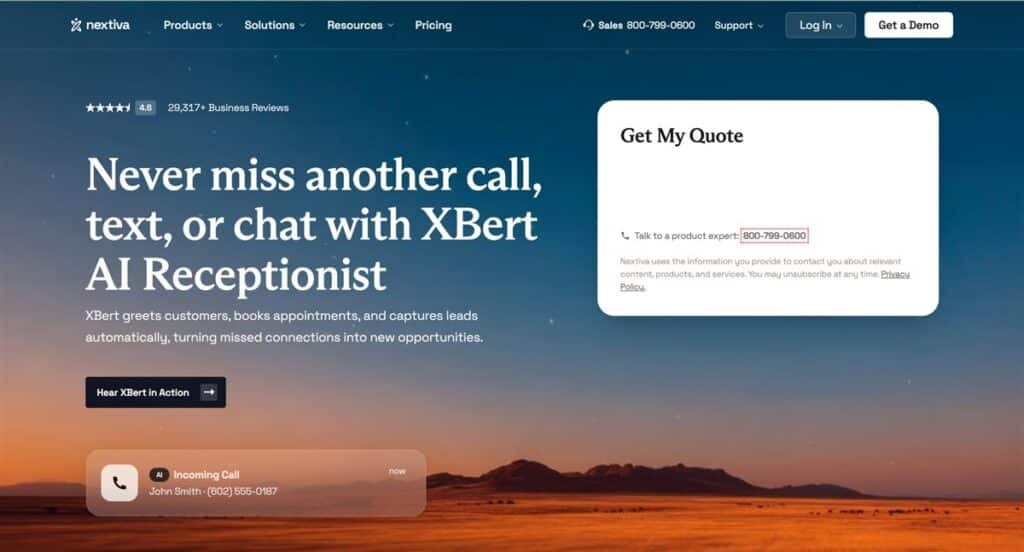
XBert is Nextiva’s AI receptionist. It answers calls, texts and website chats 24/7 from one platform, which suits practices where patients reach out on every channel.
Why it fits medical practices: Nextiva signs a BAA on its HIPAA plans and says XBert runs on a HIPAA-compliant, SOC 2-audited platform. Practices already on Nextiva can add it without changing anything else.
Worth knowing: On HIPAA plans, Nextiva deliberately switches off voicemail transcription, voicemail-to-email and visual voicemail. Texting is allowed only when no patient health information is sent or received.
Pricing: $99 a month for 100 interactions, then $0.99 per interaction, added to a Nextiva phone plan.
4. Allo
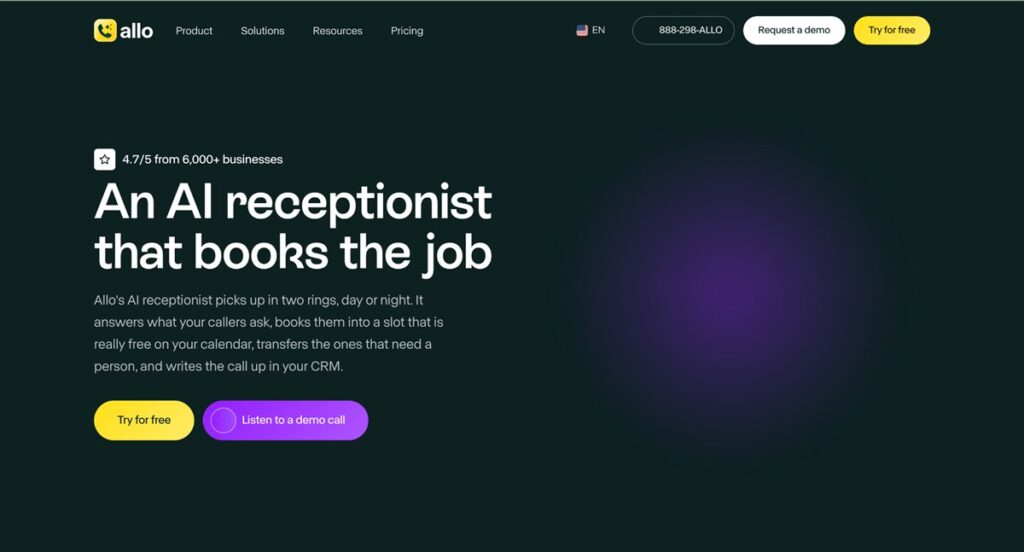
Allo is a business phone system with an AI receptionist add-on that answers calls, books appointments, takes messages and texts follow-ups. Your numbers move onto Allo, and porting them is free.
Why it fits medical practices: Allo signs a BAA for the whole workspace on its Business and Ultra plans. The agreement covers calls, recordings, transcripts, AI summaries, messages and contact records, one of the broadest written scopes here. Allo also states its AI never gives medical advice and puts urgent calls through to the clinician on call.
Worth knowing: This is a phone system switch, not an add-on layer, and the BAA is a paid extra.
Pricing: Business seats cost $45 monthly). The AI receptionist adds $32 per agent a month and the BAA adds $50 a month per workspace, with a 7-day free trial.
5. Quo Sona
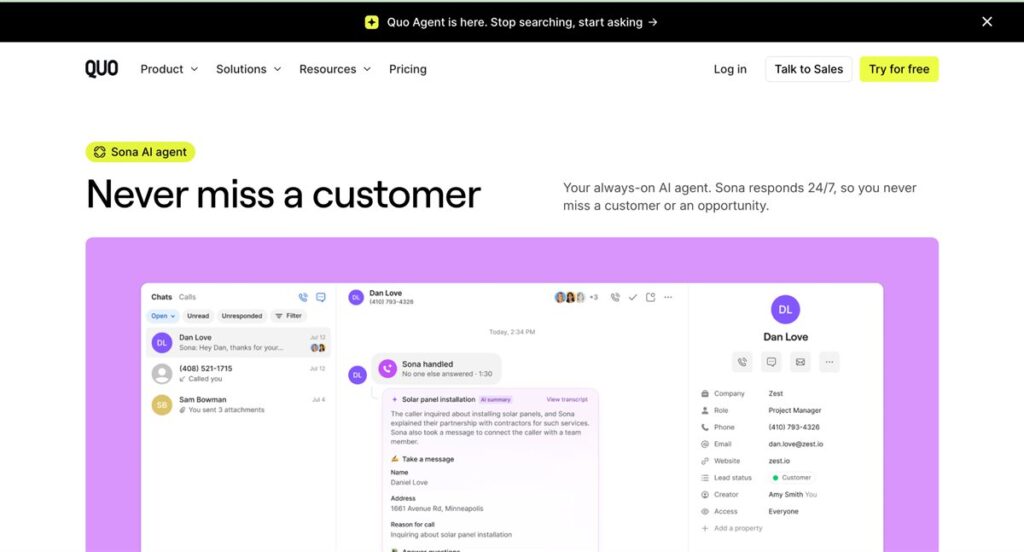
Sona is the AI agent inside Quo, the business phone system formerly called OpenPhone. It answers inbound calls as part of your existing Quo call flow.
Why it fits medical practices: Quo signs a BAA on its Business and Scale plans, and its help center is unusually clear about limits. Sona can be used under HIPAA when you give patients notice and get their authorization during the call.
Worth knowing: Texting, AI call summaries and AI call tags are not covered services under Quo’s BAA. Plan your workflow around that before switching Sona on for patient lines.
Pricing: Every Quo plan includes about 10 Sona calls a month. Paid tiers start at $25 a month for 40 calls and reach $199 for 600 calls.
6. Weave
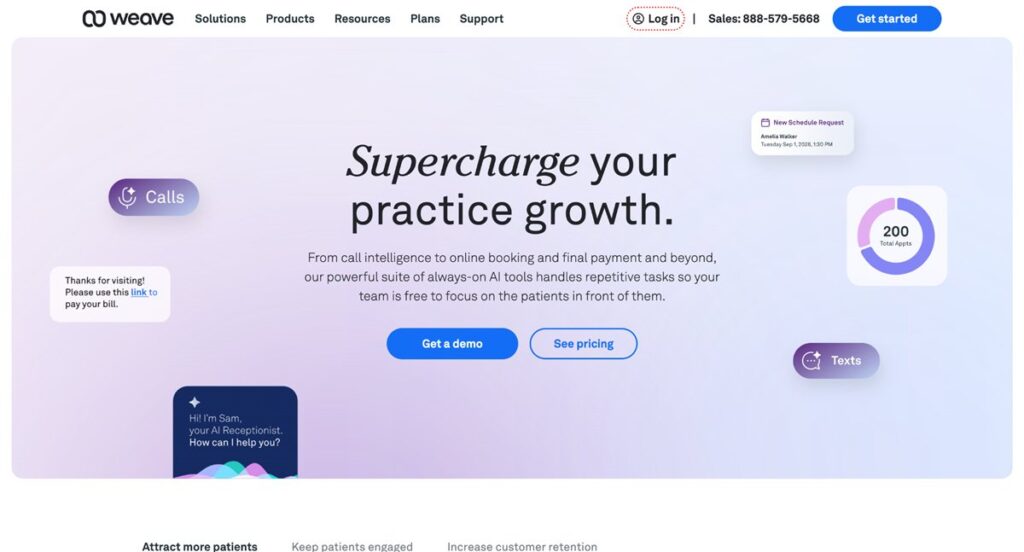
Weave is a patient communication and payments platform built for healthcare practices, and its AI Receptionist sits inside it. The AI answers calls, texts and website chats 24/7 and hands off to staff when a conversation needs a person.
Why it fits medical practices: Weave says its AI Receptionist was designed to meet HIPAA standards. AI and staff conversations share one inbox with appointment requests, invoices and digital forms, so nothing lives in a separate tool.
Worth knowing: It’s built into the Weave platform, so it suits practices already on Weave or ready to adopt it. It can also collect payments by phone and text links for overdue bills.
Pricing: Weave doesn’t list a price on its AI Receptionist page, so expect a quote.
How to choose in three steps
- Read the BAA, not the badge. Ask each vendor for its agreement and check whether it covers the AI receptionist, call recordings, transcripts and texting. If a feature sits outside it, keep patient health information out of that feature.
- Decide whether you’re keeping your phone system. Standalone options plug into the line you already have. Full phone systems ask you to port your numbers, which is free in some cases but still a migration.
- Price it on your real call volume. Pull last month’s call log and count only the calls you’d send to AI, like after-hours and overflow.
Here’s how that math plays out for a practice sending 150 calls a month to AI at about 3 minutes each. RingCentral’s standalone plan would run $49 plus 350 extra minutes at $0.50).
Nextiva would be about $148.50 in interactions plus the phone plan, and Quo’s 250-call tier would be $99 plus seats. Allo would be $114 for one seat, one AI agent and the BAA, billed yearly.
One more check before going live: script what the AI must never do. No clinical advice, no triage and a clear route to a person for anything urgent.
The phone call is rarely a patient’s first impression, though. Most check your site before they dial, so review what visitors notice first with the same care you give the AI’s script.
The bottom line
The right AI answering service is the one whose BAA covers the way your practice actually uses it.
After that, the billing unit matters more than the headline price, because minutes, interactions, calls and seats scale very differently.
Start with the agreement, then your phone setup, then last month’s call log. That order gets you to a two-vendor shortlist fast, and a free trial will settle the rest.
FAQ
Are AI medical answering services HIPAA compliant?
Some are, but only under a signed BAA, and coverage varies. Quo’s BAA excludes texting and AI call summaries, while Allo’s covers calls, recordings, transcripts and AI summaries. Always read the agreement before routing patient calls.
Do I need a BAA for an AI receptionist?
Yes, if the service will create, receive or store protected health information for your practice. Every service in this comparison offers a BAA or a stated HIPAA program, but the terms differ.
How much does an AI medical answering service cost?
Published entry prices run from $25 a month for 40 calls on Quo to $99 a month for 100 interactions on Nextiva, before any phone plan. At 150 AI-handled calls a month, the examples above land between roughly $99 and $224.
Can I keep my current phone system?
Often, yes. RingCentral’s AI Receptionist runs standalone on any phone system, and some services work by forwarding your existing number. Allo, Quo and Nextiva are full phone systems.
Should an AI receptionist give medical advice?
No. Limit it to scheduling, general questions and messages, and route anything urgent or clinical to a person.