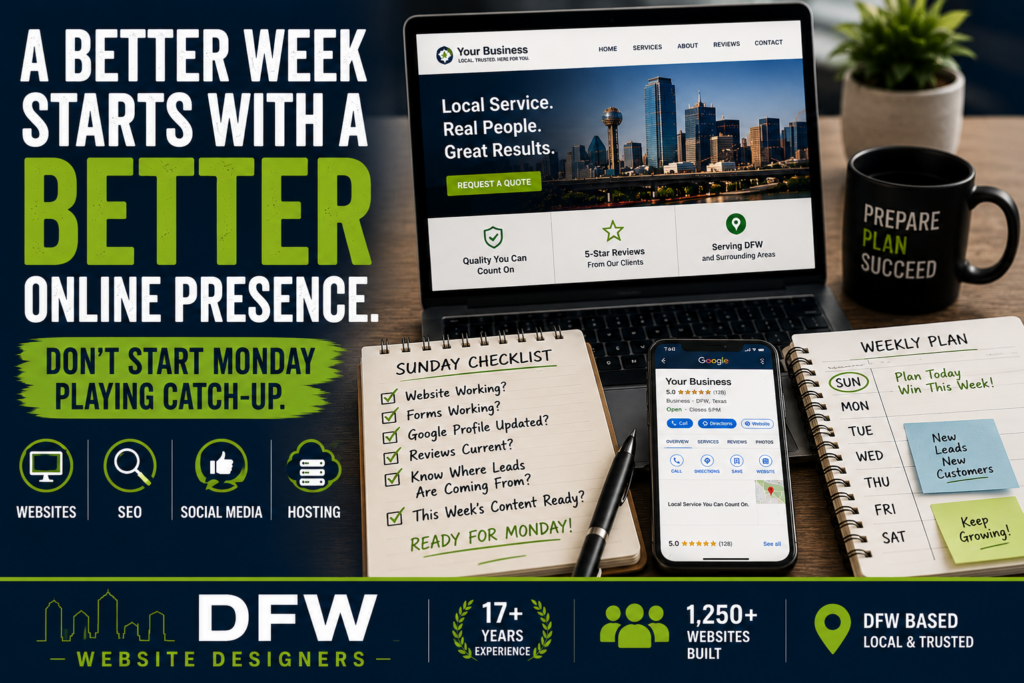
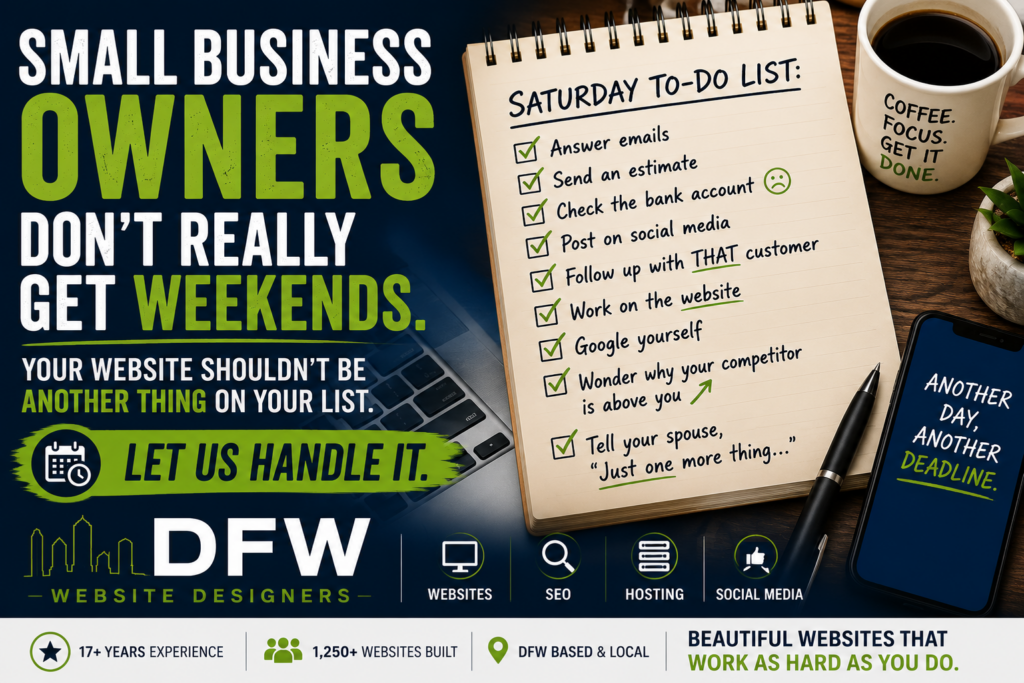
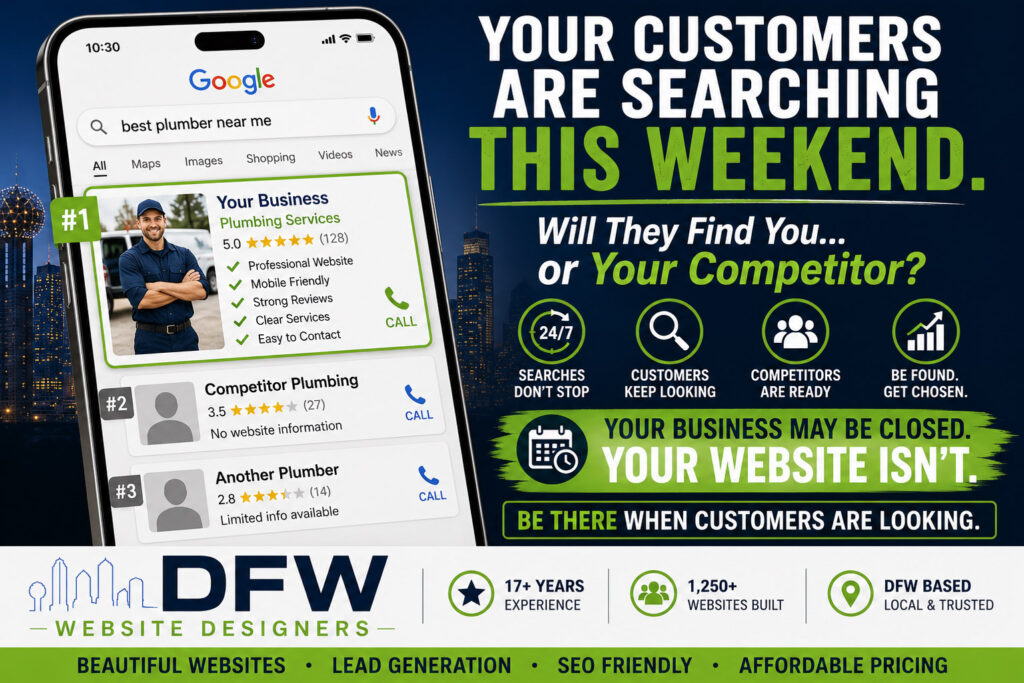
Here’s an interesting Sunday morning exercise. Pull out your phone. Open your company’s website. But don’t look at it like the owner. Pretend you’ve never heard of your company before. You don’t know the employees. You don’t know how long you’ve been in business. You don’t know that your customers love you. You don’t know that you answer the phone at 9:00 at night when somebody has an emergency. You’re simply a potential customer who found this company online. Now ask yourself one question: Would I trust this business? That’s a much harder question than: Do I like my website?
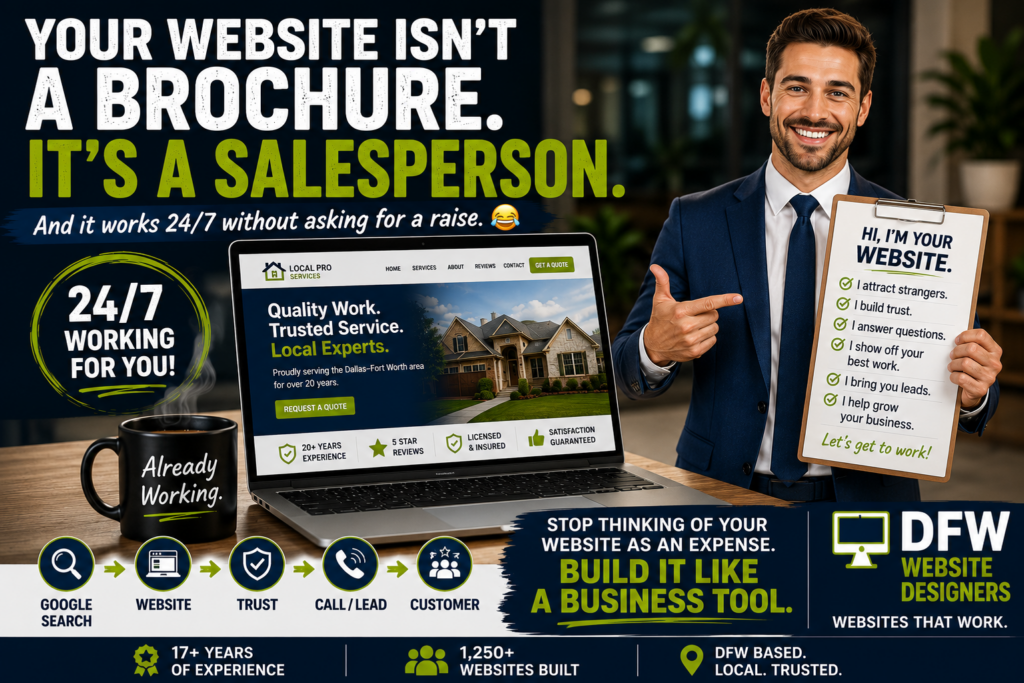
At DFW Website Designers, we’ve built more than 1,250 websites over the past 17+ years, and we’ve learned that a successful small-business website has to do something long before it generates a phone call. It has to generate trust.
Your Customers Are Checking You Out
Think about how you choose businesses today. Someone recommends a contractor. What do you do? You Google them. You see an attorney’s advertisement. What do you do? You Google them. A neighbor recommends an HVAC company. You Google them. You find a plumber through Google Maps. You read some reviews. Then what?
There’s a pretty good chance you visit their website. BrightLocal’s 2026 Local Consumer Review Survey found that 54% of consumers visit a business’s website after reading positive reviews. The same research found that 85% say positive reviews make them more likely to use a business. That’s an important combination. The review may get someone’s attention. Your website helps confirm the decision. The customer is essentially asking: “Does everything else I see about this company make me comfortable enough to call?”
Your Website Is Part of the Background Check
Customers aren’t necessarily thinking: “I shall now conduct an extensive digital credibility analysis of ABC Plumbing.” They’re sitting on the couch watching television with one eye while scrolling on their phone with the other.
But they’re still evaluating you. They notice things. Does the website look professional? Is the information current? Are there reviews? Are there pictures of actual people? Does the company appear established? Can I figure out where they’re located? Does the phone number match what I saw on Google? Do they actually provide the service I need? Can I easily contact them? Does this feel like a legitimate company? They’re gathering little pieces of evidence. Each one either adds trust… or subtracts it.
Trust Builder #1: Professional Website Design
Let’s start with the obvious one. Your website should look professional. That doesn’t mean it needs 47 animations, a video playing behind every headline, or a homepage that looks like it belongs to Apple. You’re a local business. Your customer doesn’t need Cirque du Soleil. They need confidence. A professional website should feel intentional.
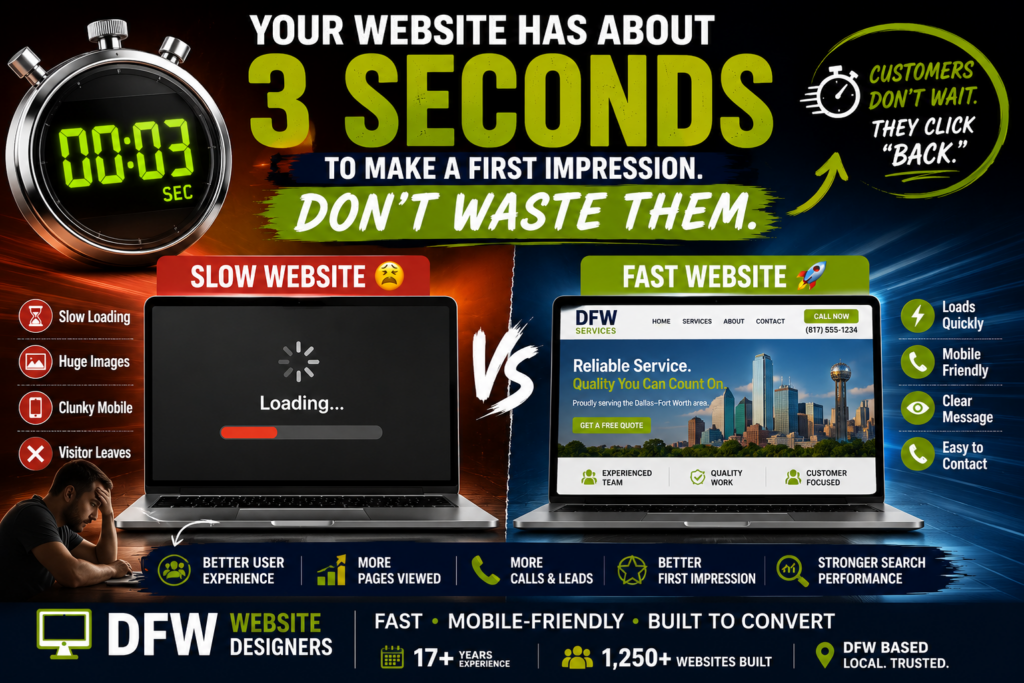
The colors should work together. The fonts should be readable. The photos should look good. The navigation should make sense. The pages should work correctly. The mobile version should actually be usable. Your website doesn’t need to look expensive. It needs to look cared for. Because if the website looks abandoned, customers may wonder whether the business is too.
Trust Builder #2: Real Customer Reviews
Reviews are one of the strongest forms of credibility a local business can show. And customers aren’t simply looking at the average star rating anymore. They’re looking at: How many reviews do you have? How recent are they? What do customers actually say? Does the company respond?
BrightLocal’s 2026 research found that 47% of consumers won’t use a business with fewer than 20 reviews, while 74% said they care about reviews written within the previous three months. That means the five glowing reviews you collected in 2019 aren’t necessarily carrying the same weight today. Your reputation needs to look alive. If you have great reviews on Google, consider showcasing some of that credibility on your website too. You’re not bragging. You’re providing evidence.
Trust Builder #3: Real People
One of my favorite improvements to a small-business website is often incredibly simple: Show the people. Show the owner. Show the team. Show the technicians. Show the office staff. Show the crew. Customers like knowing who they’re dealing with.
There are certainly places where stock photography is useful, but if every person on your website looks suspiciously like they just stepped out of a toothpaste commercial, customers can tell. Real doesn’t have to mean perfect. I’d rather see a good photograph of the actual owner standing in front of the company truck than a perfect stock photo of “Generic Smiling Business Executive #4837.” Your people are part of your story. Use them.
Trust Builder #4: Years of Experience
If you’ve been in business for 10, 20, or 30 years… say it. If you’ve completed thousands of projects… say it. If you’re licensed, certified, insured, accredited, or professionally recognized… say it. If you’ve served the same community for decades… say it.
Customers are looking for reasons to believe you know what you’re doing. Don’t make them investigate your company like Sherlock Holmes. Put the evidence where they can see it. At DFW Website Designers, for example, we’re proud to say we’ve been doing this for 17+ years and have built 1,250+ websites. Those aren’t decorations. They help answer an important customer question: “Have these people done this before?” Yep. A few times.
Trust Builder #5: Clear Contact Information
Nothing makes me suspicious faster than visiting a business website and being unable to figure out how to reach the business. No phone number. No location. No contact information. Just: “Submit this form and perhaps someone from the Internet will contact you someday.” No thanks.
If phone calls matter to your business, display your phone number. If you’re a local company, tell people where you operate. If customers visit your location, make the address easy to find. If you serve specific communities, explain your service area. Your contact information shouldn’t be an Easter egg.
Trust Builder #6: Recent Projects and Current Content
Want another quick way to show that your business is alive and working? Show recent work. Project photos. Case studies. Before-and-after pictures. Recent blog posts. News. Customer stories. New employees. Completed jobs. Community involvement. It doesn’t have to be complicated. The message is simply: We’re here. We’re active. We’re doing business. That’s powerful.
Trust Builder #7: A Secure, Usable Website
Trust also comes from the experience itself. Does the website work properly? Does it use HTTPS? Does it display correctly on a phone? Can people easily distinguish the main content? Are visitors immediately attacked by three popups asking them to subscribe, accept notifications and spin a wheel to win 10% off?
Google’s current page-experience guidance specifically encourages secure pages, good mobile presentation, good Core Web Vitals, and avoiding intrusive interstitials that interfere with the main content. Google also warns that intrusive popups can frustrate users and erode trust. That’s worth remembering. Sometimes building trust isn’t about adding something. Sometimes it’s about removing the annoying stuff.
Now Let’s Talk About the Trust Killers
Everything we’ve discussed can work in reverse. There are little things that make visitors wonder whether they should keep looking.
An Outdated Design
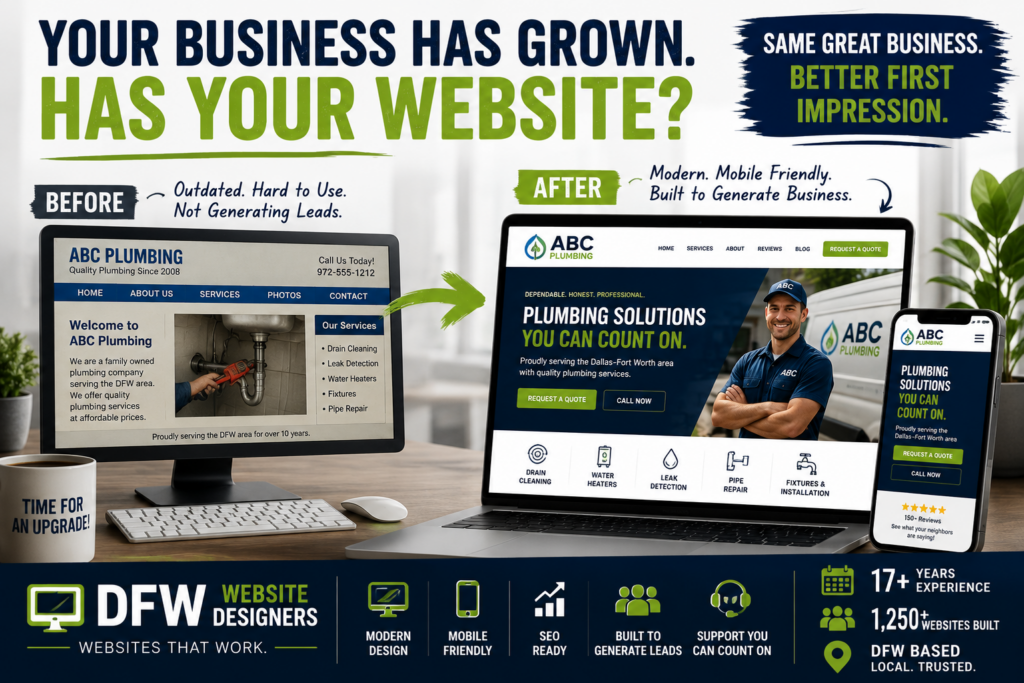
Your website doesn’t need to follow every design trend. In fact, please don’t. But if it looks like it was built when people were still excited about receiving AOL CDs in the mail… we may have a problem. An obviously dated website can create the impression that the business itself hasn’t kept up.
Stock Photos Everywhere
One stock photo? Fine. Twenty-seven perfectly diverse executives pointing enthusiastically at an invisible chart? Maybe not. Use real photos whenever you can.
No Reviews
If every competitor has dozens or hundreds of reviews and your business appears to have none, customers notice. This doesn’t automatically mean they won’t hire you. But you’ve removed one important piece of social proof.
Broken Pages
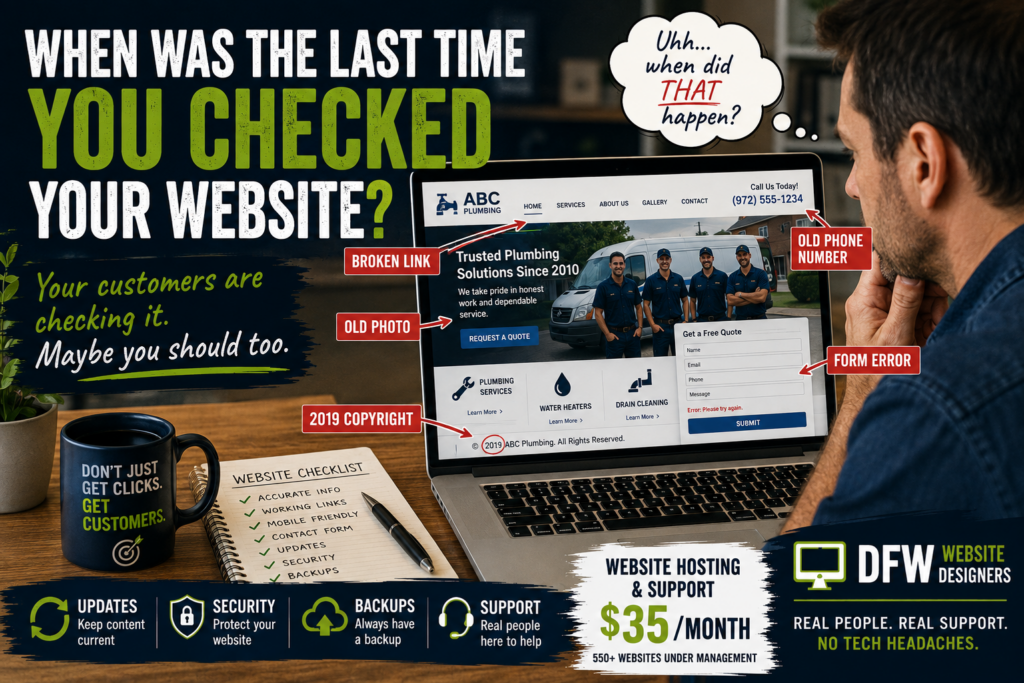
Click. 404 Error. Click. Broken image. Click. Button doesn’t work. Click. Contact form disappears into the abyss. Every little failure chips away at confidence. Remember Thursday’s lesson: Your website isn’t “done.” It needs maintenance.
Old Information
This is one of my favorites. The website says: “Come See Us at Our New Location!” The business moved there in 2017. Or: “Meet Our Team!” Half the people pictured haven’t worked there since COVID. Old services. Old employees. Old phone numbers. Old locations. Old pricing. Old promotions. Customers shouldn’t have to figure out which parts of your website are still true.
No Clear Identity
Sometimes I visit a website and genuinely cannot tell what the company does. The homepage says: “Innovative Solutions. Exceptional Results. Building Tomorrow Together.” Okay. Are you an accountant? A roofer? A software company? Do you sell sandwiches? Tell people what you do. Clarity builds confidence.
Your Website and Google Presence Need to Agree
Here’s another increasingly important trust factor: Consistency. Your Google Business Profile says one thing. Your website says another. Facebook has an old phone number. The website lists an old address. Google says you’re open Sunday. Your website says you’re closed. Now the customer has to decide which information is correct.
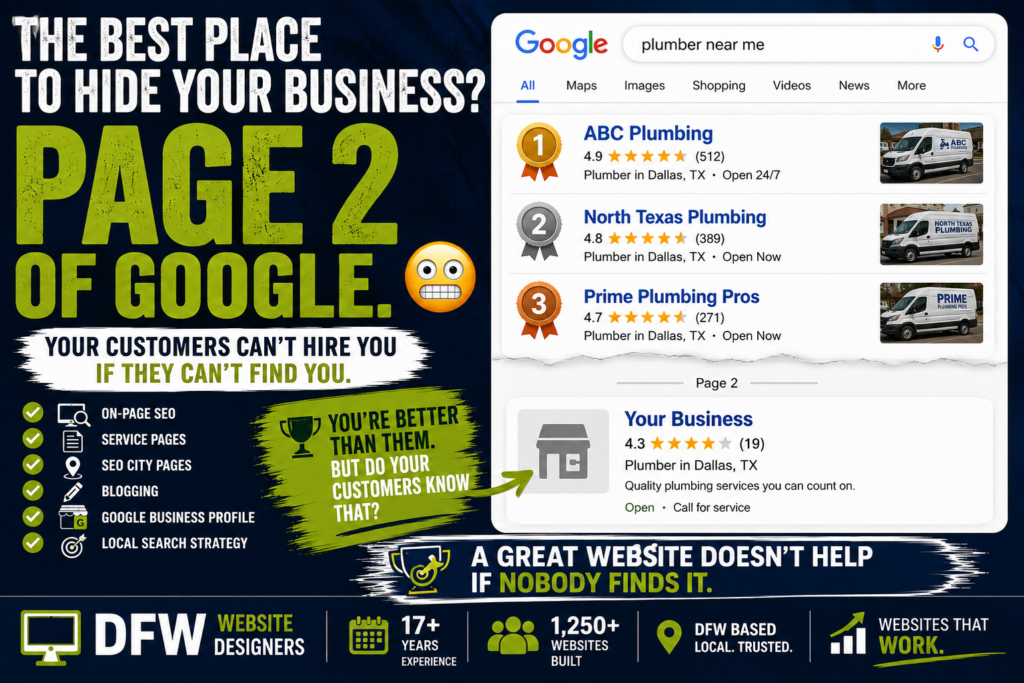
BrightLocal’s July 2026 consumer research found that customers evaluate local businesses using factors beyond simply who’s ranked first; reviews, location, pricing information and signs that listings are actively maintained all influence the decision.
That’s why your online presence needs to work together. Google. Website. Reviews. Social media. Directories. They should all tell the same basic story.
Trust Happens Before the Phone Rings
This may be the biggest point. Business owners often think the sales process starts when somebody calls. It doesn’t. It started before you knew the customer existed. They searched. They saw your name. They looked at your reviews. They visited your website. They checked your services. They looked at your photos. They compared you with two competitors. They made dozens of tiny judgments. Then the phone rang. By the time you say: “Thank you for calling…” you may already be halfway toward winning—or losing—the customer.
AI Is Becoming Part of That Research Too
There’s another change happening quickly. Customers aren’t only asking Google anymore. They’re increasingly asking AI tools for recommendations.
BrightLocal reported in March 2026 that 45% of consumers surveyed had used AI tools for local-business recommendations, up significantly from the prior year. That makes having a clear, consistent and credible online presence even more important. Your website needs to clearly communicate: Who you are. What you do. Where you work. What services you provide. Why customers choose you. What customers say about you. The internet is no longer simply a collection of blue links. But credibility still matters.
Try the Sunday Trust Test
Here’s your homework. Take 15 minutes today and look at your website. Again, pretend you’re a stranger. Give yourself one point for each YES: Does the website look professional? Does it work well on my phone? Can I immediately tell what the company does? Can I immediately find the phone number? Does it show real customer reviews? Does it show real people? Does it explain our experience? Does it show recent work? Is the information current? Do all the links work? Does the contact form work? Does it clearly explain where we provide service? Does it give me a reason to choose this company? And finally: If I knew nothing about this business, would I trust it enough to call? That’s the question that matters.
People Buy From Businesses They Trust
You can have great SEO. You can rank well on Google. You can run Facebook ads. You can send postcards. You can post on social media every day. You can generate traffic. But eventually, the customer has to decide: Do I trust these people enough to give them my money?
Your website should help answer that question. Before the salesperson speaks. Before the estimate. Before the appointment. Before you ever answer the phone.
At DFW Website Designers, we’ve spent more than 17 years helping businesses throughout Dallas–Fort Worth build websites designed to do more than simply exist online. We build websites designed to help businesses: Look professional. Build credibility. Get found. Generate leads. And win customers. Because a website shouldn’t just tell people you’re in business. It should give them a reason to trust you with theirs.